Alumni, Intel STS, Science News
Meet the 2026 SN 10: Scientists to Watch
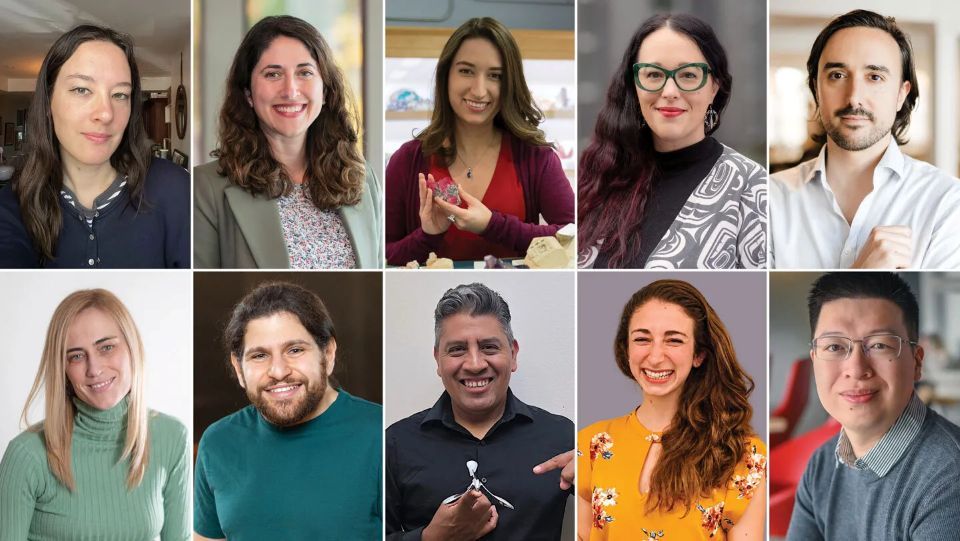
Among this year’s honorees is Science Talent Search alumna Gabriela Farfan, the Smithsonian’s curator of gems and minerals.
Science News, published by Society for Science, has released a series of videos featuring researchers from its 2026 SN 10: Scientists to Watch list. Every year, Nobel laureates and recently elected members of the National Academy of Sciences nominate early- and mid-career researchers for the list. Science News then selects the final 10 for their potential to shape the future of their fields. This year’s honorees work in subjects ranging from astronomy and physics to neuroscience, health and medicine.
We were excited to see Science Talent Search alumna Gabriela Farfan, who placed 10th in 2009, on this year’s list. “I was deeply honored and excited to hear the news! As a Science Talent Search alumna, it felt especially meaningful to still be connected to Society for Science,” Gabriela said.
Today, she is the curator of gems and minerals at the Smithsonian National Museum of Natural History in Washington, D.C. At the 2009 STS gala, Gabriela sat next to geologist Jeffrey Post, then curator of the Smithsonian’s gem and mineral collection. Jeffrey became one of Gabriela’s foremost mentors, and Gabriela eventually succeeded him as curator.
For her STS project, Gabriela investigated what gives Oregon sunstones their color and how tiny copper inclusions make them gleam. Today, she studies the chemistry and structure of coral skeletons and other biominerals for clues about the waters they grow in. In a recent study, Gabriela examined coral skeletons from museum collections around the world. Now, her postdoctoral researcher Mind Chomhom is studying aragonite crystals, the mineral that makes up coral skeletons, under controlled conditions. The experiments could help the team understand how trace elements get into coral skeletons and what those elements can tell us about the waters where the corals grew.
Though her research has changed, Gabriela has always been interested in how minerals can help answer questions about our natural world. “I find that science is an ongoing process—it’s incredibly rare to be able to answer a big question with just one study,” Gabriela said by email.
Below, meet all 10 honorees and explore their work.
Gabriela Farfan, Smithsonian National Museum of Natural History
Isabel Angelo, SETI Institute
When a star’s light differs from what astronomers would expect, astronomer Isabel Angelo looks into why. She spends her days looking through telescope data for anomalies. She uses machine learning models to sift through the large amounts of telescope data and flags any unusual observations. Then she hones into that finding and investigates what might explain the anomaly.
Isabel still draws inspiration from the 2019 reveal of the first image of a black hole, especially struck by the ingenuity and collaboration it took to use telescope data to make one single image. Among the researchers who helped develop the methods to make that image was Katie Bouman, who competed at the International Science and Engineering Fair in 2005.
Víctor Ortega Jiménez, UC Berkeley
Víctor Ortega Jiménez studies how flamingos use their movements to draw food toward their bills. He wanted to know what caused the ripples he saw while the birds were feeding. He found that when the flamingos pulled their heads back, they created tiny whirlpools that swept algae toward their curved bills. The technique flamingos use to feed could potentially inspire new ways to filter microplastics and other harmful substances out of water.
Yian Yin, Cornell University
When a research proposal is rejected, should a scientist revise it or totally scrap the idea? Computational social scientist Yian Yin studies how scientists respond to setbacks, including what happens when they revise rejected proposals. In his work, he used machine learning to analyze accepted and rejected research proposals at scientific journals and found that researchers who stuck with their projects and incorporated feedback tended to find success sooner.
Giulia Menichetti, Harvard Medical School
Computational physicist Giulia Menichetti maps compounds in food to explore how they may affect the gut microbiome and human health. Her team uses AI to comb through published studies and build a database of which compounds have been found in which foods. Her team cataloged nearly 7,000 different molecules in raw garlic alone. Many of the compounds they’ve catalogued received little attention in studies of diet and health. She wants to understand how these molecules interact with one another and what they do in our bodies. Her work could help explain why two foods that look similar on a nutrition label might affect our gut bacteria differently.
Jennifer Grenz, University of British Columbia
What helps a landscape recover after a wildfire? Jennifer Grenz, an ecologist and member of the Lytton First Nation, draws on Indigenous oral histories and ecological records to focus her work on this question. By collecting oral histories from individuals who cared for the land over time, Jennifer examines the historical ecology that may have made some landscapes more vulnerable. Her lab plans to study how roots and soil microbes might influence which plants grow back after a fire. Jennifer’s work is driven by a sense of responsibility to her ancestral lands in British Columbia.
Rebecca Pinals, Stanford University
The blood-brain barrier, also known as the BBB, acts as a gatekeeper, helping nutrients pass from the blood into the brain while keeping out many harmful substances and germs. But it can also block some medicines from reaching the brain. Rebecca Pinals and her team used human cells to build a model of the barrier in a tiny chamber on a microchip. She wants to use this model to study whether nanoparticles could help carry medicines across that barrier. Watching her grandmother decline from dementia inspired Rebecca to study the human brain.
Dor Minzer, MIT
We are at a point in history where mathematicians are competing with AI to solve age-old (and new) mathematical questions. At MIT, Dor Minzer uses math to prove when there isn’t a quick way for a computer to solve certain math problems. His work asks how a computer can tell whether a set of rules can almost all be satisfied using a machine or almost none can. In September, Dor and two of his MIT graduate students posted a paper after learning OpenAI was about to announce a proof for the same problem. It became a race to see who could publish first. A mentor sparked Dor’s curiosity about the limits of computing when he was an undergraduate. Today, he helps his students explore questions they are intrigued by.
Stefano Martiniani, New York University
Physicist Stefano Martiniani uses computer algorithms to design materials that can control how light travels. His team designed metamaterials called gyromorphs, which help block certain wavelengths of light from any direction. Metamaterials such as gyromorphs could have applications in smartphones and computers. In an optical computer, for example, light carries information across a chip. When the light goes around a corner, some of it can escape, weakening the signal. Gyromorphs could help keep more of that light on track.
Sebnem Ece Eksi, Oregon Health & Science University
Sebnem Ece Eksi investigates how tumors and the nervous system communicate. Her work has shown how closely these two areas of research are linked. Nerve fibers can be hard to see in tumor samples. Could mapping those fibers show how tumors and nerves interact as cancer progresses? Eksi wants to see whether AI can pick out and map nerve fibers in images of tumor samples.
Explore the full 2026 SN 10 package here at Science News.