Conversations with Maya: John Pardon
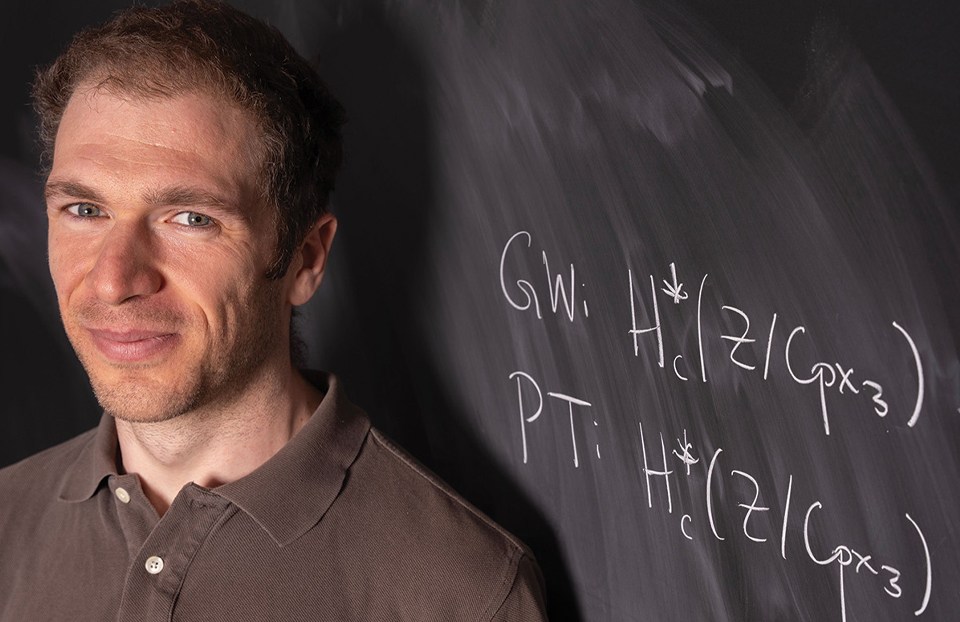
Maya Ajmera, President & CEO of Society for Science and Executive Publisher of Science News, sat down with John Pardon, a professor at Stony Brook University and a recipient of the 2026 Fields Medal. Pardon, who won a Breakthrough Prize in 2025, is a 2007 alumnus of the Science Talent Search (STS), a program of Society for Science.
What was it about mathematics that captured your imagination when you were young?
Mathematics always came very naturally to me and offered a never-ending world to explore. I could just continue to ask questions. Mathematics is the fundamental language of reality, so one’s daily experiences can offer continuous mathematical stimulation.
What are your favorite memories from participating in STS?
It was nice to experience being in a large group where interest in science and math was the norm, rather than the exception.
Your Fields Medal citation points to extraordinary achievements in symplectic geometry and topology. For those of us who aren’t mathematicians, how would you explain these subjects? Topology is the mathematical study of the properties of shapes and spaces that do not change, even when an object is stretched, twisted or bent. For example, in topology a sphere and a donut are different because a donut contains a loop which cannot be contracted to a point without leaving the donut, while a sphere does not.
Symplectic topology studies high dimensional surfaces “with a way of measuring two-dimensional area.” This definition belies an extraordinarily rich topological theory and ubiquitous appearance in mathematical physics. For example, many evolution systems, such as the rotation of the solar system, may be fruitfully studied by interpreting them as flows on certain symplectic manifolds.
How did it feel to win the Fields Medal, and what does the honor mean for you?
It’s a little bit overwhelming, to be honest. It’s been less than two months since the award was publicly announced, and I’m still getting my bearings.
What can mathematics reveal about the universe that we might not be able to see or understand otherwise?
Whether you’re describing the structure of atoms, the behavior of light or even just how long it takes a ball to fall to the ground, you can’t get anywhere close to understanding physical phenomena without serious mathematics.
As a mathematician working on these problems, is there an “aha moment” that happens?
Absolutely. I’ve had a few of these aha moments. Although not every paper has one, I usually remember when I have such a moment. A lot of my work involves a series of smaller “ahas.” In order to reach such a moment, you need to fully immerse yourself in a problem and understand every aspect of it. And then maybe you have an “aha” moment when you’re not expecting it.
As AI becomes increasingly capable of tackling difficult mathematical problems, do you think it will fundamentally change the way mathematicians do their work if it hasn’t already?
AI has already changed mathematics in a big way, and will continue to do so for the foreseeable future. AI is developing so fast that whatever I say will almost certainly be outdated a year from now (if not by the time this interview is published). AI models can truly understand high level mathematical arguments in a way computers never could in the past. This means that a supercomputer can test many more potential lines of attack on mathematical problems than a single person can. However, the computational cost remains high.
How does that impact your work?
We are still learning how to best use AI. Everyone uses it differently. AI is great at finding subtle errors in mathematical arguments. My writing is usually quite terse and difficult for human experts to understand. However, I have used AI to find (usually easily fixable) errors which are quite subtle. The ability to locate such errors shows how skilled AI is at mathematics. I have also used AI to find a few nontrivial proofs (things I was pretty sure were true, but hadn’t quite put the pieces together yet).
On the other hand, AI has been less successful in answering some of the more serious research questions I have asked it. Probably one needs some serious computing power for these, and even then it would likely be hit-or-miss.
If AI can solve a mathematical problem that no human can solve or produces a proof that humans struggle to understand, what does that mean for your work or for mathematics?
So far, the proofs AI has produced haven’t been very different stylistically speaking from proofs written by humans. I should also note that humans have been writing hard-to-understand proofs for a very long time. So having a proof which is hard to understand is nothing new.
The length of the proofs produced by AI are, again, reasonable by human standards. Eventually, maybe it will just sit there thinking about math on its own, and it can become an oracle we can ask questions of. Maybe at some point it will understand more math than humans do, with us asking it questions and then trying to understand the answer. But I expect this is a somewhat distant future. The computing power required is probably put to better use for other needs, such as AI medical applications.
What advice would you give to a young person who’s discovered a subject they’re passionate about but they don’t know where the subject might take them?
You don’t ever really know where something’s going to take you. Having something you are passionate about is a great position to be in: Recognize that and follow it.
You recognized your passion very early on and continued on that path. Did you ever think of deviating from mathematics?
In high school, I did a lot of computer programming in addition to mathematics. During my undergraduate career at Princeton University, I found that I fit better with the math department than the computer science department. Had I gone to a different school, perhaps I would have followed a different path. I also played the cello throughout high school and my undergrad years; however, it wasn’t really a serious career option for me.
What are you reading right now, and what books had an impact on you when you were young?
Right now, I am reading two books. One is The Courage to be Disliked by Ichiro Kishimi and Fumitake Koga. The other is a Chinese martial arts novel by 金庸 (Jin Yong). The best book I have read of his is most definitely 笑傲江湖 (sorry, the title is in Chinese, and translations don’t really do it justice). His skill in writing can be seen through his chapter titles in this book: Each is perfectly expressed, yet consists of just two characters. (I read these novels in the original Chinese, which I studied at Princeton — there’s so much there that’s untranslatable).
When I was young, I read a lot of math books, a favorite being Functional Analysis by Michael Reed and Barry Simon. I read some science fiction/fantasy (though not as much as certain nerd stereotypes would suggest), including Dune by Frank Herbert and the Lost Years of Merlin series by T. A. Barron.
There are many challenges in the world today. What’s keeping you up at night and what gives you hope?
AI and political situations throughout the world are worrisome. It’s hard to point to a place anywhere without some sort of instability or bad actors.
It is encouraging to interact with people in the surrounding community and realize that they are much more reasonable than the people who appear in the news.