How Adam Sidman uses engineering to make movies feel real
If you’ve seen the 2018 thriller Searching, you might have wondered how it was shot. A father frantically searches for his missing daughter, and the whole story unfolds on computer screens. It’s a far cry from the brick-and-mortar sets you might picture when you think of Tinseltown.
Behind the scenes, filmmaker Adam Sidman wanted the actors to see and react to one another in real time without worrying about the technology. So his team built a closed-circuit TV system out of off-the-shelf parts, adapting a setup he’d originally developed for another film you might be familiar with, Unfriended.
“We had a few non-negotiables. The actors needed to be able to perform against each other without delay, and they needed to be able to live in their environments without worrying about all of the technology. We wanted them to really feel like they were communicating with one another,” Adam says.
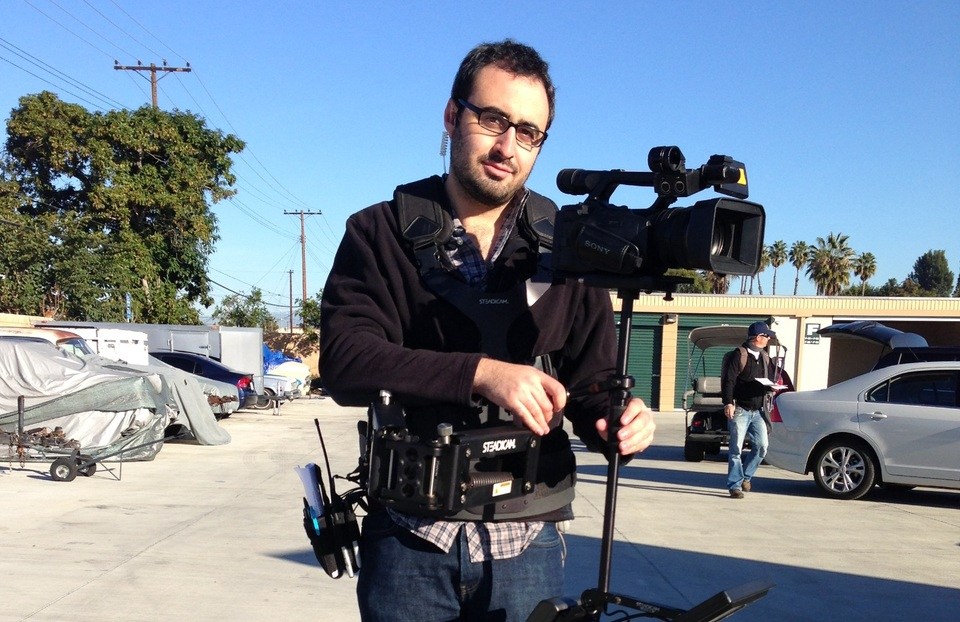
In high school, Adam was already honing his craft. He made short films with friends, worked at a local CBS station and shot commercials for businesses in his hometown of Colorado Springs. He wanted a better way to steady his camera while filming. Sensors and motors had advanced enough for him to build a stabilizer he could use on his own shoots.
“It’s funny to think that the same approach was at the heart of my stabilization project,” Adam says. The stabilizer had to correct for movement as it happened. Years later, on Searching, his setup had to relay video quickly enough for the actors to respond naturally to one another.
Adam presented the stabilizer at the International Science and Engineering Fair (ISEF) in 2005 and brought an improved version to the Science Talent Search the following year. Fielding questions from judges and other finalists at ISEF helped him figure out how to explain what made his project distinctive.
“I think I always knew I wanted to work in entertainment, but I didn’t really grasp how many different roles there were,” Adam says of his high school shoots. “At the time, I was often doing most of them myself.”
At Harvard, Adam went on to study mechanical engineering and film, taking classes across a broad swath of fields. He cross-registered at MIT for classes in optics and at the Media Lab. Today, he thinks of himself as “a filmmaker who thinks like an engineer.”
“I didn’t have one big break so much as a series of opportunities to take on more responsibility,” Adam says. He went from handling most of the jobs himself on small shoots to overseeing U.S. production at Bazelevs. Taking on Unfriended was one of those pivots. The film’s webcam conversations required him to rethink how to shoot a movie so it felt like a real video call.
Adam has always enjoyed the collaborative side of filmmaking and the sheer fun of making something entertaining and sharing it with other people. “The more I think about it, the more parallels I see with engineering,” he says. “In both cases, you’re creating something for other people to use or experience, and a lot of the same design, problem-solving and creative skills go into finding new solutions.”
He also credits the mentors who challenged him and expected as much from him as they did from colleagues with far more experience. “Maybe one day they’ll all get thanked in an Oscar speech,” he says.
Now Adam and his team are working to launch an AI platform to help filmmakers visualize scenes and plan productions together before shooting. He sees it as another tool filmmakers can use to do more without compromising what they want to create. In some ways, he says, it’s the same goal he had when he built his camera stabilizer in high school. He wants to give filmmakers more freedom to bring ambitious ideas to the screen.
“I’m particularly interested in stories where the creative ambitions might have been out of reach using conventional production methods,” he says. “I’d like to keep finding ways to make those stories possible.”
Adam returned to ISEF as a judge in Technology Enhances the Arts, a category that brings together his two longtime interests. “I signed up on a whim when ISEF was in my home city of Los Angeles, but I was also particularly interested in being part of the inaugural year of the Technology Enhances the Arts category,” he says. “I got hooked and have traveled to the fairs ever since.”
Interested in judging at Regeneron ISEF? Learn how to volunteer as a Grand Award judge.