The Hammoud twins are making room for change
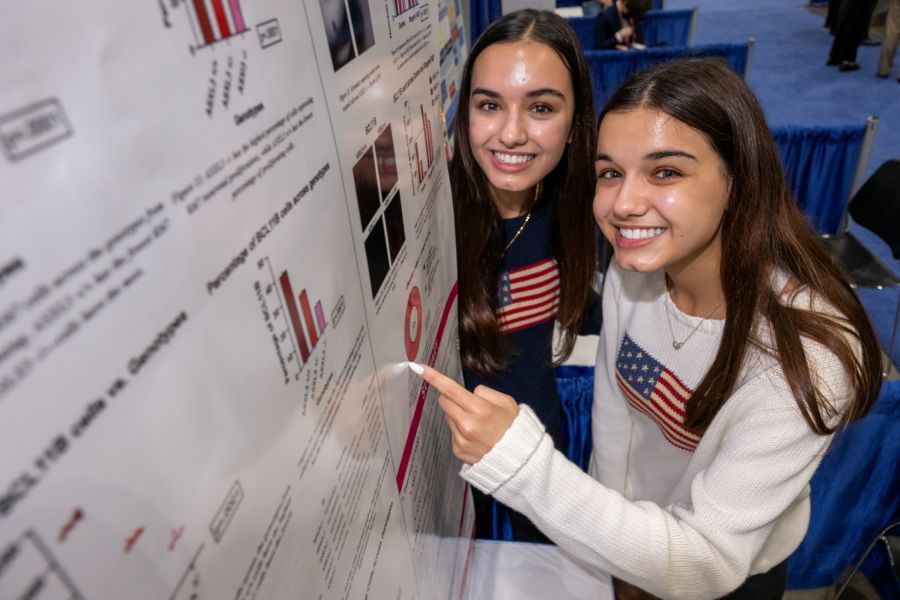
Last month, Maya Hammoud spoke at the Concordia Annual Summit in New York, held alongside the United Nations General Assembly. Her panel, “From Future Leaders to Present Power: Youth at the Diplomatic Table,” explored how young people can help shape global decisions.
Maya brought the perspective of someone already doing that work with her identical twin sister, Lara.
“If you are making policy for a specific group, it is not enough simply to allow that group to voice their perspective,” the sisters said. “They need to be actively involved in writing and shaping the policy itself.”
Now Harvard students, the twins have built an international organization and pursued award-winning neuroscience research. Both were finalists at the Regeneron International Science and Engineering Fair (ISEF) in 2024 and 2025. Their 2025 project, “Decoding ASXL3: A Novel Predictor of the Spectrum, Onset, and Treatment for Neurodevelopmental Disorders,” explored a gene’s role in brain development and a possible therapeutic approach in lab models.
The questions that brought them to scientific research, and eventually to international stages, began with a dear childhood friend.
Years ago, the sisters built a sensory room for a friend with autism. Then they began noticing how many other places offered no such accommodation.
“If we wanted to go to the movie theater with him or even to the park, we often couldn’t because there was no sensory-friendly space available,” they recalled. “That made us realize this was not just an issue for our friend, but a larger need across Michigan.”
One room and a whole lot of empathy grew into the Perception Foundation. The sisters began building sensory spaces across their home state, learning how to raise money and persuade others to invest in their ideas.
“Our first funding was very scrappy: bake sales, selling bracelets and fundraising through things we could make ourselves,” they said.
Small grants helped them scale. Today, grants and individual donors support the organization, while local chapters raise money for community projects. According to the twins’ website, the foundation now spans more than 71 countries, with more than 265 branches and a reported reach of over 694,000 people.
Affordability has been central to that growth. A traditional sensory room can cost around $40,000, the sisters explained. They say their model reduces that cost by 96.7% while retaining the components they consider essential.
“That model has allowed us to deploy sensory spaces in communities that otherwise may not have had access to them.”
Their friendship also prompted questions that building sensory spaces alone could not answer. They wanted to understand more about the biology behind neurodevelopmental disorders and whether genetics could offer more objective additional insight into diagnosis.
At ISEF in 2024, the twins investigated ASXL3, a gene linked to neurodevelopmental disorders, and its potential as a biological indicator of those conditions. In 2025, they expanded their research to examine how changes in the gene affect developing neurons and whether a growth factor could help restore neuron numbers in tissue models.
They earned first place in Cellular and Molecular Biology in 2024 and third place in the category in 2025. Behind those awards were repeated experiments, including roughly 10 revisions to their CRISPR approach.
“That process taught us to constantly reevaluate rather than becoming attached to a particular method,” they said.
“I think one of the best parts of ISEF is that you become the expert in your own field. It gives you the autonomy to explore ideas that may never have been tested in your area before.”
The Perception Foundation keeps their scientific questions connected to the real-life people who inspire them.
“Working with the Foundation has given us a unique perspective because we not only see the need for research firsthand, but also see the direct benefits that research and innovation can ultimately bring to the communities they serve,” they said. “It makes the science feel human and, in many ways, more meaningful.”
Their partnership has its own division of labor. Lara generates ideas; Maya brings optimism and logistical organization. “As we like to say, she comes up with the ideas of what we want to do, while Maya is very optimistic and will figure out how to turn those ideas into reality,” they explained.
They do not always agree on the route. During their research, Lara wanted to investigate when diagnosis might become possible, while Maya wanted to focus on when treatment could begin. They ultimately agreed that understanding the timing of diagnosis needed to come first. “I think it all comes down to compromise and listening to each other’s perspectives. We may approach a problem differently, but those differences often make the final result stronger.”
Their work has drawn coverage from CBS News Detroit, WXYZ and FOX 2 Detroit. Their speaking engagements, including at United Nations gatherings, address disability rights, mental health, women’s leadership and youth activism.
“It has been such a surreal experience,” they said.
This summer, Maya joined Regeneron Science Talent Search finalists Edward Kang and Claire Jiang at Aspen Ideas: Health. Moderated by Francis Collins, former director of the National Institutes of Health, their panel explored how young researchers are approaching challenges in science, technology and health.
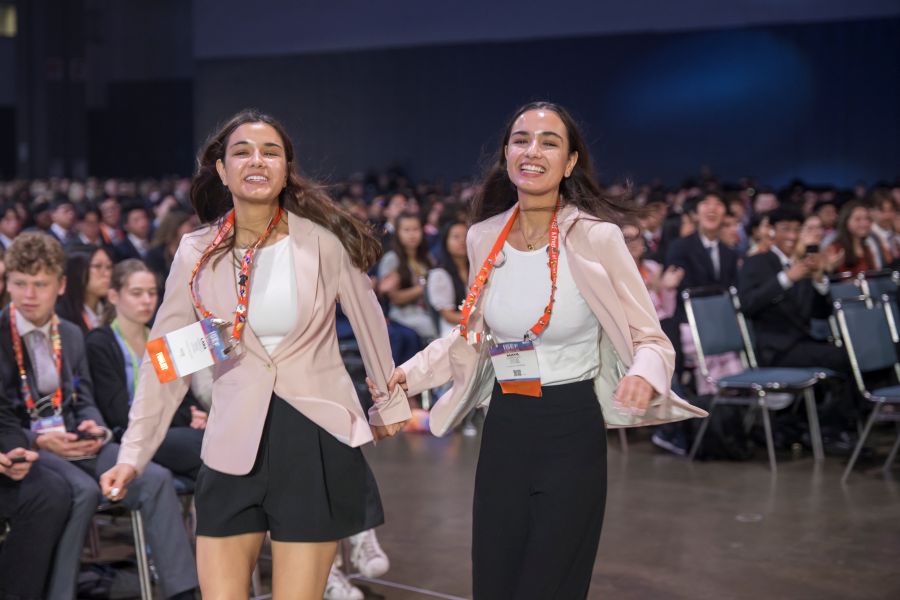
Their return to Regeneron ISEF as symposium speakers offered another moment to take stock. The twins arrived in matching pink suits and white heels to lead “Beyond the Spectrum: How Youth-Led Innovation is Rewiring Inclusive Design.” Having presented their research as finalists, they were now inviting students to design products that could help prevent sensory overload. The sisters described it as an opportunity to “come full circle.”
“We met some of our closest friends through ISEF, and being surrounded by some of the brightest high school students in the world gave us access to an incredible network,” they said. “The Society for Science has created such an amazing community that has continued beyond the competition, including into the business world. It really feels like a second family.”
At Harvard, both are considering paths in neuroscience, along with applied mathematics and potentially government.
“We are excited to watch it grow and evolve alongside us throughout college, while continuing to build on the work we started when we were much younger.”
That work still holds a simple, personal ambition: for a friend, and for people they may never meet, an ordinary outing to the movies or the park should be possible.