Reaching for the moon: Regeneron ISEF 2026 projects inspired by lunar exploration
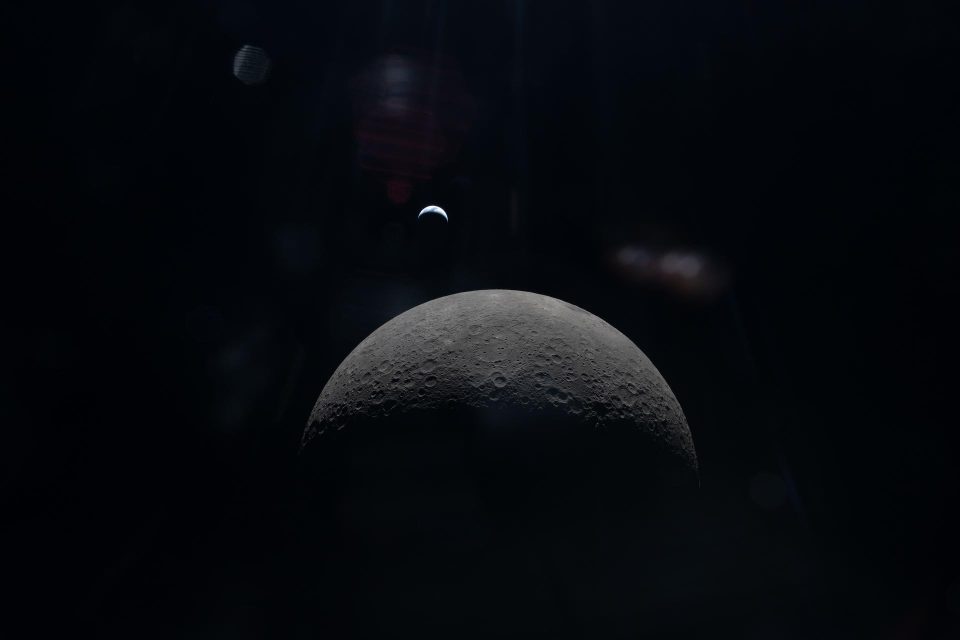
Today is International Moon Day, which marks the anniversary of the Apollo 11 moon landing in 1969.
The historic mission fulfilled President John F. Kennedy’s goal of landing humans on the moon and returning them safely to Earth. Neil Armstrong and Buzz Aldrin became the first people to walk on the lunar surface while Michael Collins remained in lunar orbit aboard the command module. While on the moon, the astronauts conducted scientific experiments, collected lunar samples to bring back to Earth and photographed the moon’s terrain.
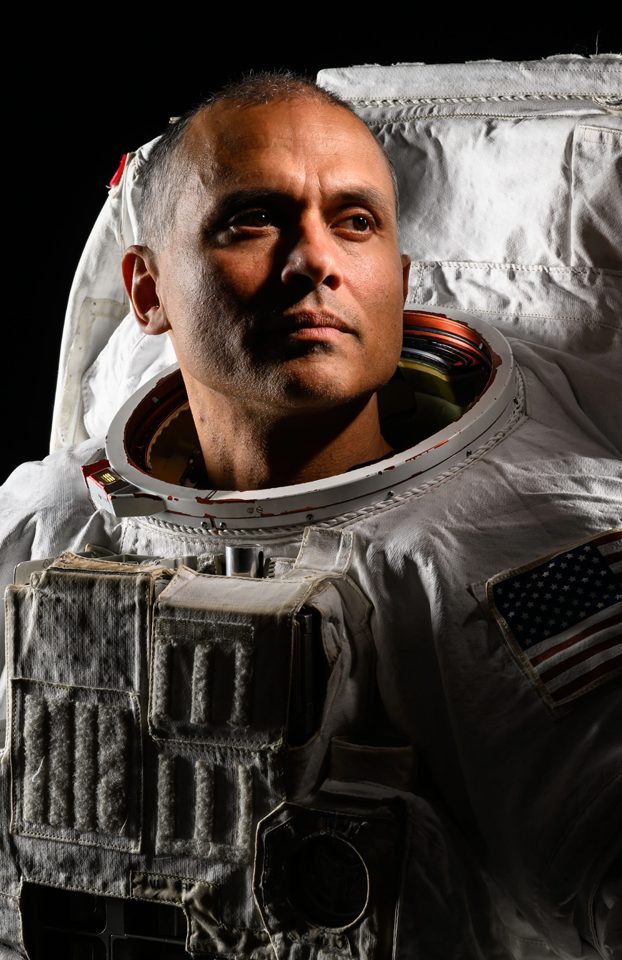
As we reflect on this historic achievement, International Moon Day is also an opportunity to consider how much scientific progress has been made over the past 57 years, from returning astronauts to the moon to preparing for future space exploration. Science Talent Search alum (1999), Anil Menon, a former SpaceX flight surgeon, is currently aboard the International Space Station (ISS) on his first spaceflight. During his eight-month mission, he will conduct scientific research and technology demonstrations aimed at advancing human space exploration and benefiting life on Earth. Menon will also perform ultrasound using augmented reality and artificial intelligence methods that could eliminate the need for medical support from Earth on future space missions, such as to the moon and Mars.
Take a dive into research projects from this year’s Regeneron International Science & Engineering Fair finalists that are inspired by the moon, spanning categories from Materials Science and Engineering to Astronomy and Software Design.
Clara Allen
Springville High School, Springville, Utah
Age 16, junior
Since future space exploration may one day involve human beings inhabiting the moon, manufacturing materials from the moon would be beneficial. Clara researched the possibility of using moon dust or basaltic volcanic ash (BVA) for her Regeneron ISEF project. Using a 3D printer with a BVA-loaded polymer, Clara tested how materials withstood the wide range of lunar temperatures. The tests showed that the 3D-printed materials couldn’t handle the moon’s extreme daytime heat. The materials softened at high temperatures, and the moon dust prints became brittle and crumbly when heated in conditions like those on the moon. These results seek to aid our knowledge for future lunar missions and potential long-term habitation.
Ankan Das
Oviedo High School, Oviedo, Florida
Age 15, sophomore
In his Regeneron ISEF project, Ankan developed a compact robot with a flexible frame that can absorb impacts, change shape, and move through tight spaces. He designed the robot so multiple units could eventually work together as a swarm to explore challenging environments. The autonomous mobile robot successfully traversed across a variety of surfaces, including simulated lunar soil (known as regolith), concrete and pavement. It is now being tested in extremely hot and cold temperatures, as well as in a chamber filled with simulated lunar soil, to see how well it could perform in conditions like those on the Moon.
Reagan Dispennette,
Spruce Creek High School, Port Orange, Florida
Age 17, junior
For her Regeneron ISEF project, Reagan used a trained machine learning model and physical models to identify lunar lava flows. This research could be used by scientists to find the most promising landing sites on the moon and learn more about its geological history. Using images of the lunar surface captured by NASA’s Lunar Reconnaissance Orbiter, Reagan identified surface features with more than 94% accuracy. She also learned that thicker lava flows took longer to cool than thinner ones, providing new insights into how the moon’s surface formed.
Eduardo Ayarza-Freyre
Colegio Rosa-Bell, Guaynabo, Puerto Rico
Age 15, freshman
Eduardo’s research introduces RegoCrete-BGX, a fiber-reinforced, multi-aggregate concrete made with lunar regolith, basaltic rock and waste glass for future space construction. If we plan on landing on the moon, Eduardo’s research explores how structures could be built using materials available on the lunar surface. He created concrete blocks using different combinations of these materials and tested how much weight they could withstand after curing for one and two weeks. His findings suggest that simulated lunar soil can be combined with chosen Earth-based materials to produce concrete with strength comparable to traditional concrete. This could help limit the amount of building material that future space missions may need to transport from Earth.
Jacob Rivera
Dr. Pedro Albizu Campus, Ponce, Puerto Rico
Age 17, senior
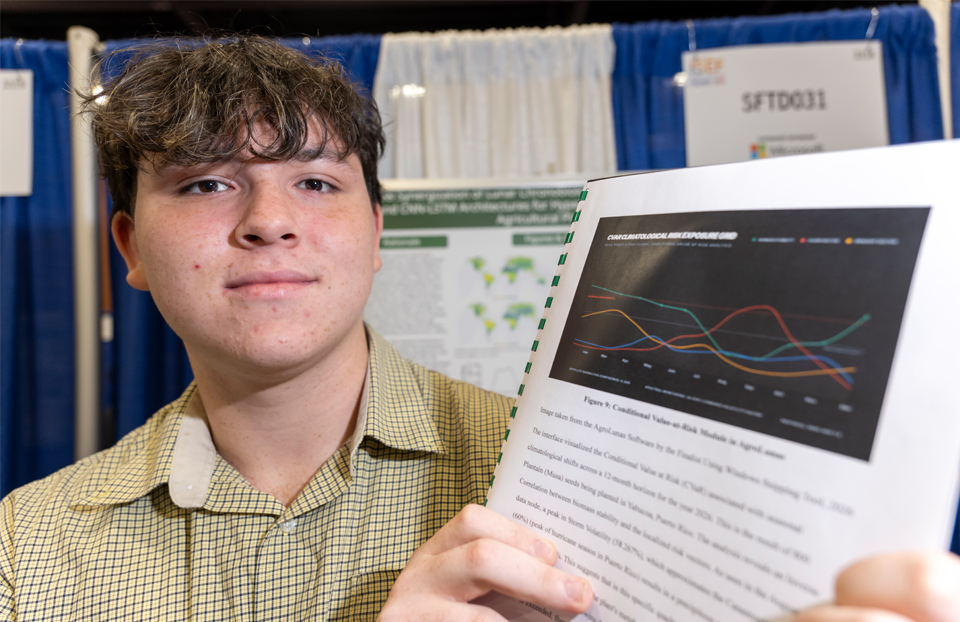
Jacob researched how farmers can adapt to climate change by using the moon as a point of reference. As climate change makes weather more unpredictable, many farmers can no longer rely on traditional planting calendars. Using his software development system, AgroLunas, Jacob combined modern weather data with insights from lunar cycles to help farmers make more informed planting decisions. Delivered through an interactive platform, the system helps farmers combine ancestral knowledge with modern atmospheric
For more from the fair, watch the Regeneron ISEF 2026 highlights video!