Rivka Lipkovitz, STS 2025 Fifth Place Winner, Is Still Following the Numbers
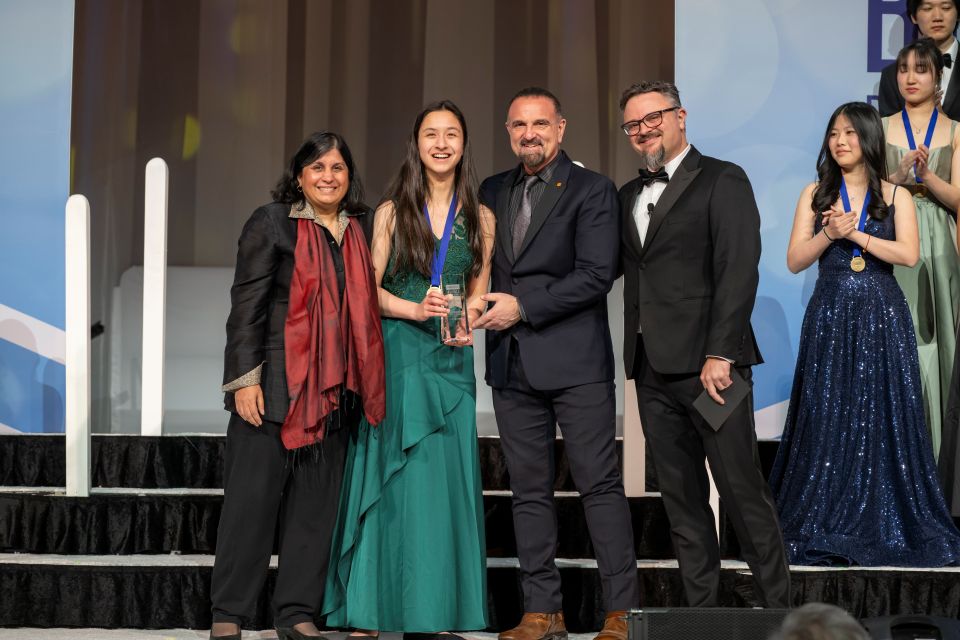
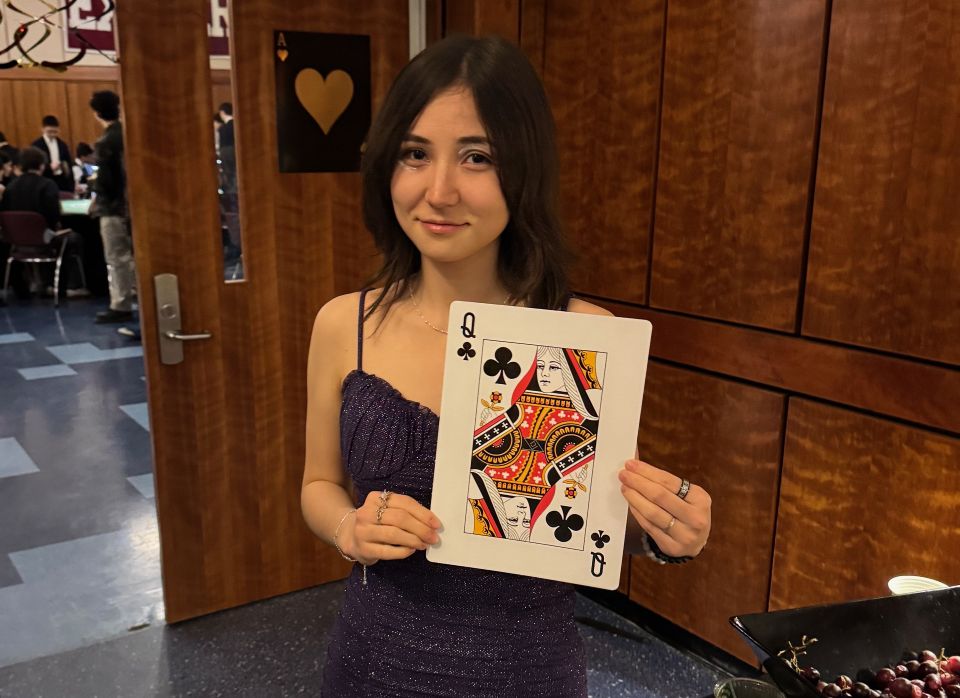
When Rivka Lipkovitz placed fifth in the 2025 Regeneron Science Talent Search, she had already spent years exploring how mathematical models could shed light on real-world questions. For her project, she analyzed decades of U.S. voter turnout data to examine the effects of strict voter identification laws. Her research has also been featured in Forbes and has been published in research publications.
Now a freshman at MIT, Rivka is continuing to pursue the kinds of quantitative questions that first drew her to research. Outside the classroom, she’s also a competitive speedcuber who can solve a Rubik’s Cube in under 10 seconds.
We asked Rivka about her advice for this year’s finalists, what she learned through her research, and what she’s been exploring during her first year at MIT.
What advice would you give this year’s STS finalists about exploring new topics or trying unconventional approaches in their research?
“My advice to this year’s finalists would be to stay curious throughout your time in college. Even if your academic focus stays mostly the same, go to seminars outside your niche and explore adjacent fields.” Rivka says that approach has already shaped her own academic interests. “I stayed in quantitative social science, but branching out a bit made me realize that I’m increasingly interested in labor economics.”
Your project analyzed trends in voter turnout using statistical modeling. What did you find most interesting about the patterns you discovered?
“This project made me appreciate how rarely policy impacts are clear-cut,” Rivka said. Turnout appeared to increase in midterm elections after voter ID laws were implemented, “but only in some models.”
Because of that complexity, she focused on what the data could reliably support rather than drawing sweeping conclusions.
“I didn’t conclude that voter ID laws increase turnout. Instead, I used this information to conclude that it’s very unlikely they decrease turnout in midterms.”
She was also surprised by how much the timing of the laws mattered.
“I was surprised by how much the effects seemed to depend on when a state adopted the laws, which suggested that context matters a lot. More broadly, when the results aren’t definitive, the best we can do is weigh the evidence carefully and make the most reasonable decision based on what we know.”
Rivka continued refining the project after the competition and submitted it to a journal, where it was published this past December.
What was your most memorable experience from the Regeneron Science Talent Search?
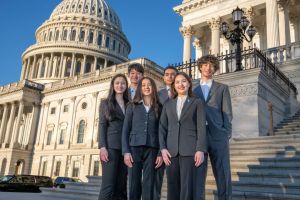
“One of my most memorable moments was the very first day, when the finalists from my region arrived and we all met in person,” Rivka recalled. “It felt surreal to be in D.C. with people I’d only known online before the competition.”
She also remembers how quickly the finalists fell into deep conversations.
“The dinner conversation was really lively,” she said. “We were debating big questions, like whether AI could create bioweapons and what a workable regulatory framework would be if that scenario became plausible.”
You moved from San Francisco to Cambridge to attend MIT. What has the transition been like, and what have you been exploring so far?
“The transition was easier than I expected,” Rivka said. “Boston is similar to San Francisco in that both are large cities on the water.”
She quickly built a community with classmates and dormmates.
“I’ve been fortunate to make friends in my dorm and classes, and we’ve spent some weekends exploring Boston.”
The biggest adjustment has been the weather. Like fellow STS 2025 top ten winner, Logan Lee, Rivka is “…still getting used to needing a heavy jacket and gloves,” she said. “At the same time, playing in the snow is fun, and we even had a blizzard last week that was severe enough that we built a huge igloo and hung out together inside for an hour.”
Academically, she has been taking both core requirements and more advanced courses. “I’ve been taking some of my graduation requirements, such as chemistry and physics, along with more specialized electives, including graduate probability and labor economics.” The probability class in particular pushed her mathematically. “Probability was one of the most abstract and challenging classes I’ve taken, and it linked together almost all of the math I had learned previously. At the same time, completing the problem sets was very rewarding, and I feel the class helped me grow into a more capable mathematician.”
She has also begun assisting with research on applying machine learning to causal inference with MIT econometrician Whitney K. Newey.
If you could have dinner with any STEM professional, living or past, who would it be and what would you want to ask them?
Rivka says she would choose American economist Thomas Schelling, whose work she encountered in an class during her first semester at MIT. Schelling, who was awarded the Nobel Prize in Economic Sciences for his work applying game theory to understand conflict and cooperation, stood out to her for the way he approached economics almost like a natural science.
“What I found so compelling about Schelling is how he explained complex social outcomes using really simple assumptions about human behavior,” Rivka says. “For example, small preferences, like not wanting to be in the minority, can end up producing large patterns such as segregation and often inefficient equilibria.”
If she had the chance to speak with him, Rivka says she would want to explore how those ideas apply today. “I’d want to ask what modern problems he thinks are still driven by these kinds of population dynamics,” she says, “and then brainstorm what it would look like to design policies that could shift systems toward better equilibria.”
To learn more about this year’s incredible finalists and their hard work, join us on Sunday, March 8, at the Conrad Hotel from 1:30 p.m. to 3:30 p.m. for the Public Exhibition of Projects during STS Finals Week. More information about the students can also be found here.