Regeneron Science Talent Search 2026 Recognizes America’s Top Young Scientists, Awarding More Than $1.8 Million to High School Seniors for Innovative Research in Computational Mathematics, Neural Science, and Blood Cancer Treatment
$250,000 top award goes to Connor Hill in America’s longest running and most distinguished science and math competition
Regeneron Pharmaceuticals, Inc. (NASDAQ: REGN) and Society for Science (the Society) announced that Connor Hill, 17, of State College, Pennsylvania, won the top award of $250,000 in the 2026 Regeneron Science Talent Search (STS), the U.S.’s oldest and most prestigious science and math competition for high school seniors.
Key Takeaways:
- This year marks the 85th anniversary of the Science Talent Search and Regeneron’s 10th year as the title sponsor; Regeneron is extending its title sponsorship through 2036, pledging $150 million to fuel the next generation of science and technology leaders.
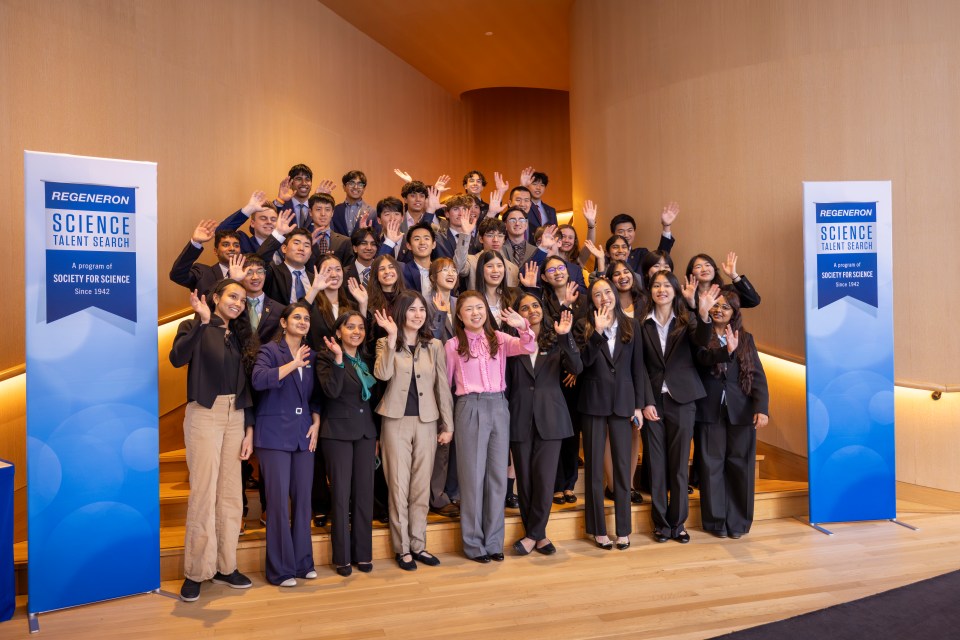
- Forty finalists were honored at the National Building Museum in Washington, D.C., receiving more than $1.8 million in awards recognizing groundbreaking research, exceptional analytical rigor, exceptional problem-solving skills and potential to shape the future of STEM.
- Top Three Winners:
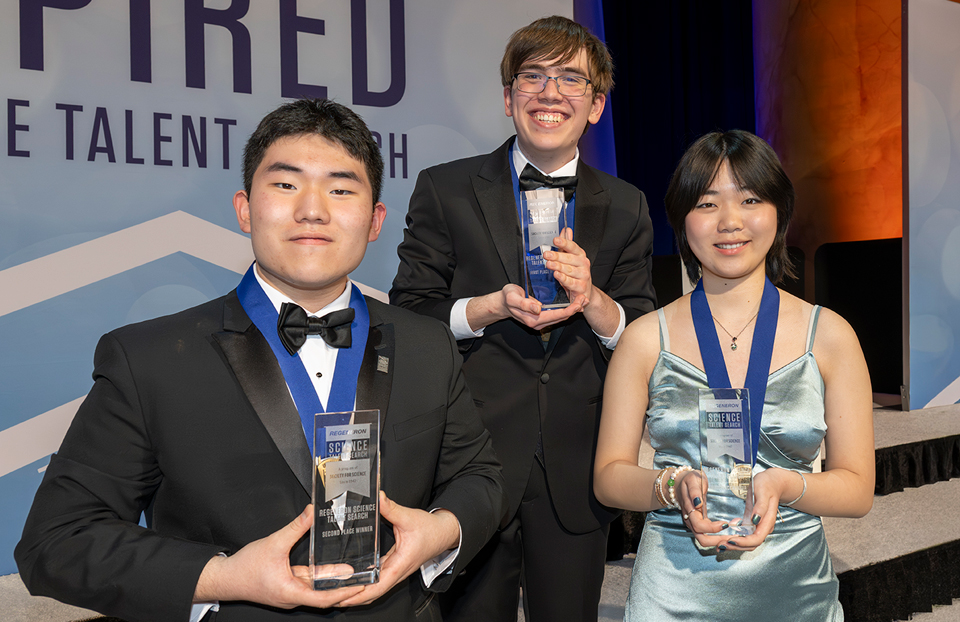
- Connor Hill, 17, of State College, Pennsylvania won first place and $250,000 for discovering a way to identify all the possible “noble polyhedra,” highly symmetric shapes with flat sides and straight edges. He wrote a computer program to do the computations and proved there are two infinite families of noble polyhedra, as well as 146 isolated examples.
-
- Second place and $175,000 went to Edward Kang, 17, of Hackensack, New Jersey for using retinal images to train AI models on subtle patterns linked to autism and attention-deficit/hyperactivity disorder to create a screening tool called RetinaMind. He also created retinal cell models to study gene changes that may help explain why these differences occur.
-
- Third place and $150,000 went to Iris Shen, 17, of The Woodlands, Texas, for testing a potential cancer drug in clams to see if they could serve as an animal model for blood cancer drug discovery. In the clams, the drug had a similar effect to what researchers observe in human cells. She also tested a mix of other potential cancer drugs, which slowed the clams’ tumor growth.
- Media Resources:
- High-resolution photos, winner bios, project summaries, b-roll, and video interviews are available in the 2026 Regeneron Science Talent Search Media Kit: https://www.societyforscience.org/2026-regeneron-science-talent-search-media-kit
-
- Media may also access the full list of 40 finalists and detailed project descriptions at: https://www.societyforscience.org/regeneron-sts/2026-student-finalists/
-
- The Science Talent Search represents a long-term commitment to the next generation of scientific leadership. It supports students’ educational pursuits and research while recognizing young scientists whose intellectual rigor and bold thinking position them to shape the future of innovation.
-
- Together, all 40 finalists join a distinguished group of Science Talent Search alumni, many of whom have gone on to achieve world-changing careers in STEM, including earning esteemed honors such as 13 Nobel Laureates, 23 MacArthur Fellowships and 14 winners of the National Medal of Science.
“Congratulations to the winners of this year’s Regeneron Science Talent Search,” said Maya Ajmera, President and CEO, Society for Science and Executive Publisher, Science News. “Their bold vision and perseverance reveal what the next generation of problem solvers truly looks like—and why our future is in capable hands. Their creativity, ambition and courage to confront the world’s toughest challenges are exactly what this moment demands.”
The Regeneron Science Talent Search is committed to providing a national platform for high school seniors to showcase original, innovative STEM research that proposes novel solutions to real-world issues. Finalists are evaluated for their scientific rigor, originality, critical thinking, leadership potential, and commitment to creating meaningful impact in crucial STEM fields.
“Congratulations to the winners of the 2026 Regeneron Science Talent Search, and to all the finalists who participated in this year’s competition. These students represent exactly the kind of extraordinary talent scientific progress depends on,” said George D. Yancopoulos, M.D., Ph.D., co-Founder, Board co-Chairman, President and Chief Scientific Officer of Regeneron and a 1976 Science Talent Search winner. “From my own experience as a Science Talent Search winner, I know the transformative power of this competition. That’s why Regeneron is deepening our commitment and extending our title sponsorship for another decade. Through our support of Science Talent Search and our title sponsorship of the Regeneron International Science Fair, the world’s largest high school science competition, we will invest more than $300 million from 2017 to 2036. We may never know where the next great scientific leader will come from, but we do know it’s our responsibility to find that talent, fuel it, and give it every chance to change the world.”
Other top honors from the competition include:
- Fourth Place and $100,000: Rachel Chen, 18, of Los Angeles, California for developing a concrete, visual way to describe systems of many quantum particles using Temperley-Lieb diagrams, expanding on a 1997 finding. Rachel illustrated how a magnetic field influences the entire quantum system using these simple point-and-line diagrams.
- Fifth Place and $90,000: Jerry Xu, 17, of Lexington, Massachusetts for building an AI program that compresses the features of protein molecules into strings of numbers. He showed that his model enabled a more efficient comparison of protein structure without the loss of important features. This could speed up genetic research and drug discovery.
- Sixth Place and $80,000: Leanne Fan, 18, of San Diego, California for building a device to simulate microgravity in order to study how wounds heal in space. With the device, she tested red light on injured flatworms and found that it sped up tissue regeneration by 95.2%. She also found that red light treatment speeds up wound repair in human models in normal gravity.
- Seventh Place and $70,000: Claire Jiang, 18, of Wyckoff, New Jersey for developing a cellular model of juvenile idiopathic arthritis (JIA). She treated cells used to study rheumatoid arthritis with bone morphogenetic protein 4, a protein linked to JIA joint damage. Her experiments showed they acted like JIA cells in their growth and gene expression.
- Eighth Place and $60,000:Leon Wang, 17, of Stamford, Connecticut, for finding two FDA-approved drugs that may also be effective against Alzheimer’s disease. Both drugs reduce the activity of a cellular signaling pathway linked to an Alzheimer’s gene. In lab-grown brain cells, the drugs reduced signs of damage due to the pathway.
- Ninth Place and $50,000: Jonathan Du, 18, of Mountain View, California for investigating the unrestricted finite factorization property. Factorization breaks down mathematical objects into simpler parts. Jonathan’s work explores complicated algebraic systems where some elements have several factorizations, and others do not factor at all.
- Tenth Place and $40,000: Seth Nabat, 18, of Winnetka, California for building a machine learning program to quickly and accurately track particle collisions without sacrificing accuracy by favoring symmetry. Seth’s program uses an unconstrained network to catch errors, and another network to find patterns in them.
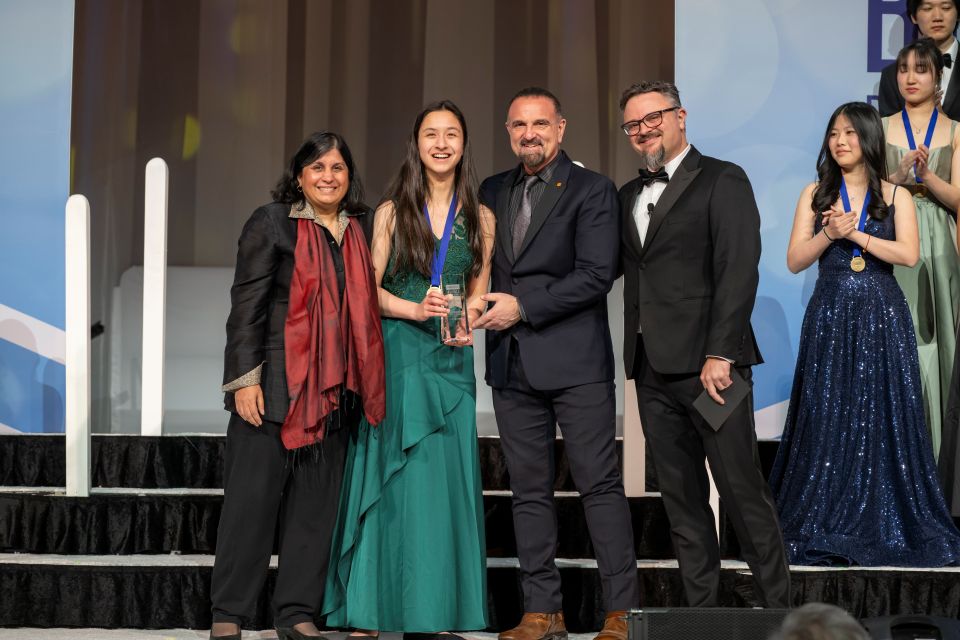
- Colin Jie Chu, 18, of Palo Alto, California was named the Seaborg Award winner and selected to speak on behalf of the Regeneron Science Talent Search Class of 2026. The 40 finalists chose Colin as the person who best exemplifies their class and the legacy of nuclear chemist Glenn T. Seaborg, who won the Nobel Prize for Chemistry in 1951 and served on the Society’s Board of Trustees for 30 years.
- The remaining 30 finalists received $25,000 each. In total, Regeneron awarded $3.1 million in awards, including $2,000 to each top scholar and their school. Since the start of Regeneron’s sponsorship in 2017 through this year’s competition, Regeneron and the Society have engaged and inspired more than 20,000 of the nation’s top young scientists, recognized 3,000 as Regeneron scholars, and awarded over $31 million in prizes.
Resources: