Five Questions with Logan Lee, the Fourth-Place Winner of Regeneron STS 2025
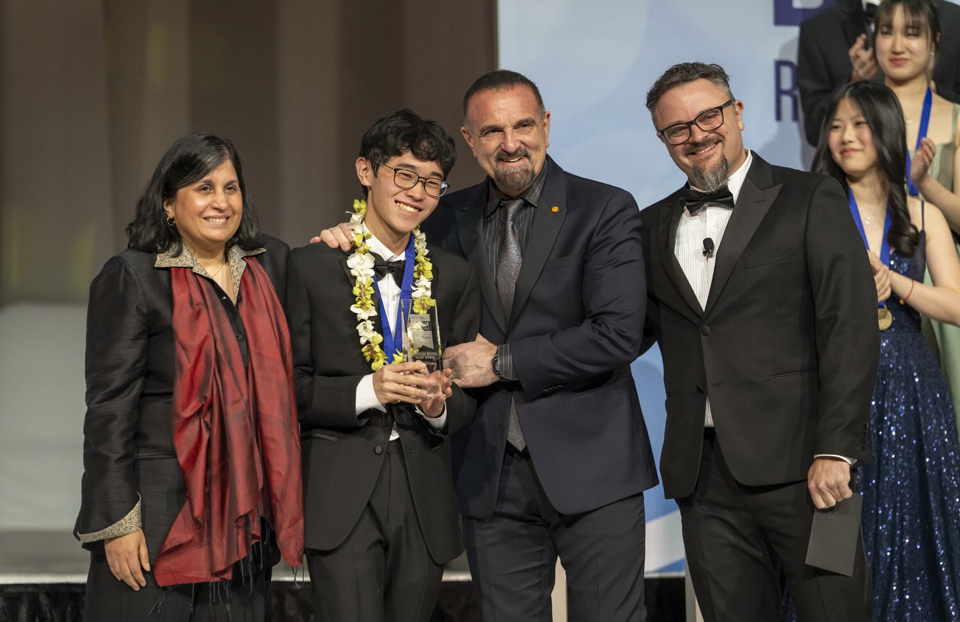
When Logan Lee first stepped outside his dorm in New Haven, Connecticut and felt the air that registered to him as “feels like -16°F,” he was in disbelief. Born and raised in Honolulu, he did not grow up needing a bulky puffer jacket or multiple layers just to walk to class. Now 18 and a first-year student at Yale, he is adjusting to East Coast winters while carrying forward the research and purpose that defined his time as a Regeneron Science Talent Search finalist.
Featured in Hawaii Public Radio, Native America Calling as well as Science News Explores, Logan came in fourth place overall during the 2025 competition, winning $100,000 that is to be used towards education. For his project, Logan studied ways to better control invasive mosquitoes in Hawaii, where avian malaria has led to the extinction of more than 30 native bird species. Current efforts release reproductively incompatible male mosquitoes that produce nonviable eggs, but these sterile males often struggle to survive in the wild. Logan boosted their survival by inoculating them with beneficial bacteria from wild mosquitoes, helping them grow faster and withstand colder conditions. In the process, he also identified a potentially novel bacterium adapted to the mosquito midgut in Hawaii.
Below, let’s hear more from Logan and his reflections on college life and scientific discovery.
Looking back on your Regeneron STS experience, what advice would you give to this year’s finalists?
Logan encourages this year’s finalists to approach the week with openness. “I would tell this year’s finalists to frame finalist week as one of growth, both individually and as a collective,” he says. “Each new day is one of transformation as you explore new areas of science, conversations with your fellow finalists, and discussions with professional scientists.”
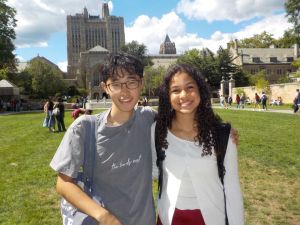
For Logan, the impact of STS did not end when the week was over. The relationships he built continue to shape his life in college and beyond. “In particular, the connections that I formed with finalists are ones that I continue to cherish to this day,” he adds. At Yale, he often spends time in the Native American Cultural Center with fellow finalist Ava Cummings and he has also reunited with Melody Hong and Kevin Shen in Boston and New York City.
How has your experience at Yale been so far?
“I have loved my time at Yale,” Logan says. The biggest adjustment has been the weather. In November and December, he watched the temperature drop lower and lower until he could not leave his dorm without a heavy coat and at least two layers underneath. What has made the transition easier, he says, are the people. Through clubs like WYBC, Yale’s college radio station, and time spent in the Native American Cultural Center, he has found community. As he wrote his responses, he was sitting in the radio station beside friends, almost able to forget the blizzard outside.
What have you been studying and working on recently, both academically and in your research?
“Being at Yale has allowed me to expand my wings, both scientifically and otherwise,” he says. Logan will double major in Molecular Biophysics and Biochemistry, and Statistics and Data Science. “Academically, double majoring will let me pursue my scientific interests while also exploring other fields through Yale’s liberal arts curriculum, including classes like Introduction to Native American Studies and Canadian Literature.”
In addition to his coursework, Logan serves on the research and development team at Simplex Sciences, a biotechnology nonprofit that produces single-stranded DNA ladders and organizes educational events in New Haven.
“Exposure to this alternate side of biological research has been particularly enriching to me, as well as the community that comes with it,” he says.
Outside the lab, he remains deeply involved on campus. “Yale has provided me with a place to both re-establish old interests and explore new ones,” Logan says, noting his work in sound engineering for the college radio, weekly SAT tutoring and science lessons for local students, serving as a poetry editor, supporting campus events and productions and acting as treasurer for YAISES, Yale’s Indigenous STEM group.
You played a key role in renaming Discoverers’ Day to Indigenous Peoples’ Day at your high school. What was it like to see that change happen, and what did you learn from being on the planning committee? Why was this important to you?
“Seeing this change happen at my school was incredible,” he says. “There’s a common misconception that administrative changes such as renaming holidays are insignificant in the grand scheme of things, but I view them as a reframing to celebrate underrecognized communities.”
For Logan, the shift was about more than a name. It was about visibility and acknowledgment.
“To see my culture be commemorated in this way, bringing both its rich traditions and modern struggles to light, and knowing that I contributed to the change, brought me immense pride,” he says. “Smaller initial changes are what allow for the biggest transformations later.”
If you could teach a computer to feel one human emotion, which would it be, and why?
When asked what human emotion he would teach a computer, Logan does not hesitate: “I would teach a computer how to feel compassion,” he says.
For him, research is fundamentally about making a tangible change for communities. “If a computer were able to feel compassion, it would understand the why behind what is being done and form an understanding of the broader expanse of the research.” He believes compassion could help address the disconnection that pervades society. “I think that this would address one of the most prevalent issues in the modern landscape of research: a disconnect from the issue being researched,” he explains. Too often, he says, research is conducted without fully grasping its reach or consequences. “To perform meaningful research is to fully understand the significance of it, at all levels.”
To learn more about this year’s incredible finalists and their hard work, join us on Sunday, March 8, at the Conrad Hotel from 1:30 p.m. to 3:30 p.m. for the Public Exhibition of Projects during STS Finals Week. More information about the students can also be found here.