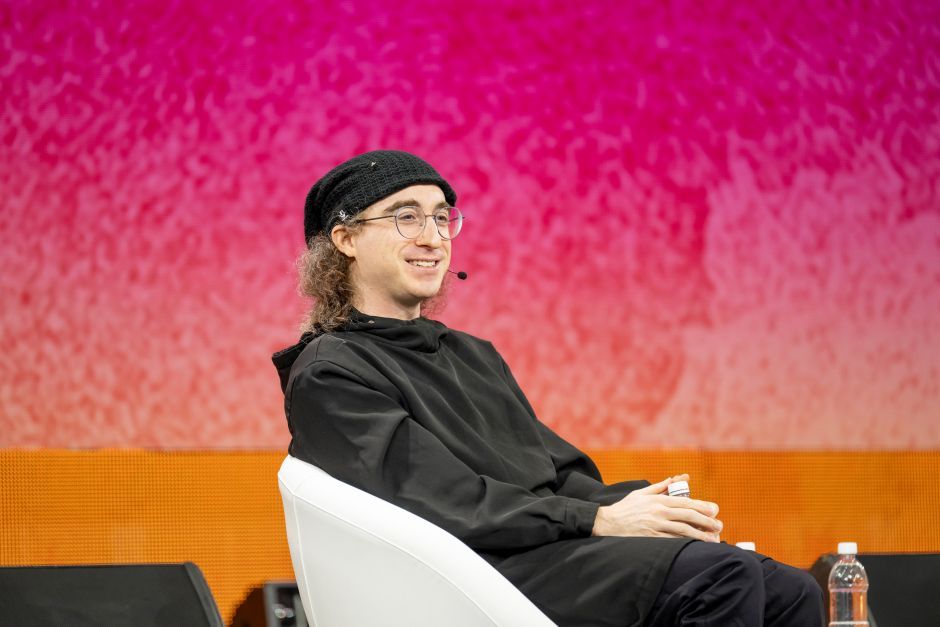
Five Questions with Cory Seelenfreund, winner of the 2025 Peggy Scripps Award for Science Communication
For Regeneron International Science and Engineering Fair 2025 top winner, Cory Seelenfreund, understanding how people cooperate isn’t just an abstract math problem, rather it’s a window into human behavior.
Cory, 18, of New Rochelle, New York, received the $10,000 Peggy Scripps Award for Science Communication for his project exploring how memory shapes decision-making in the Prisoner’s Dilemma, a classic game theory scenario in which two individuals must decide whether to cooperate or act in their own self-interest. Using computer simulations and mathematical modeling, Cory found that memory can significantly improve outcomes, especially in more complex interactions, and that a mix of altruistic and self-interested behaviors creates the strongest cooperative systems. His findings could help inform the design of smarter artificial intelligence systems and programs that need to effectively interact with humans.
Now headed to the halls of MIT to study applied mathematics, Cory reflects on his Regeneron ISEF experience, his fascination with human cooperation and the sci-fi innovation he’d most like to see become reality.
What did it mean to you to be a top winner at Regeneron ISEF 2025?
It meant the world to me. I love conducting and presenting my research, but being recognized at that level showed me that my work has the potential to create change and help solve real-world problems.
What was your most memorable experience from the competition?
Honestly, the bus ride home. I traveled back with 19 other students from my regional fair, and what started as a group of strangers became a group of close friends in just one week. We spent 10 hours solving Rubik’s Cubes, watching horror movies and laughing about inside jokes from the competition. That sense of connection was unforgettable.
What have you been working on since Regeneron ISEF?
This past summer, I expanded on my previous research by looking not just at player traits, but at environmental conditions that encourage or discourage cooperation. I found that some environments make cooperation much easier, while others actively work against it. I’m excited to keep exploring these questions in college.
If you could see one sci-fi technology become reality today, what would it be?
Psychohistory from Isaac Asimov’s Foundation. My research looks at human behavior in relatively simple interactions, but psychohistory imagines predicting behavior at a massive societal scale. I’d be fascinated to see whether anything like that could ever become possible.
What advice would you give to the next generation of scientists?
Pursue what genuinely interests you. Awards and recognition are wonderful, but curiosity should be the real driver. I always come back to the idea of “knowledge for the sake of knowledge.” Anything that helps us better understand the world has value.
Check out the Society blog for the latest stories, and be sure to tune in to the Grand Awards Ceremony on Friday, May 15 at 12 p.m. ET!