Congratulations Top Regeneron Science Talent Search Winners!
Regeneron and Society for Science announced the top ten winners of the Regeneron Science Talent Search, headed by Connor Hill, 17, of Port Matilda, PA who won the $250,000 first place award.
See the Press Release
Watch the Awards Ceremony
Learn more about the winners’ projects by visiting the Virtual Public Exhibition of Projects!
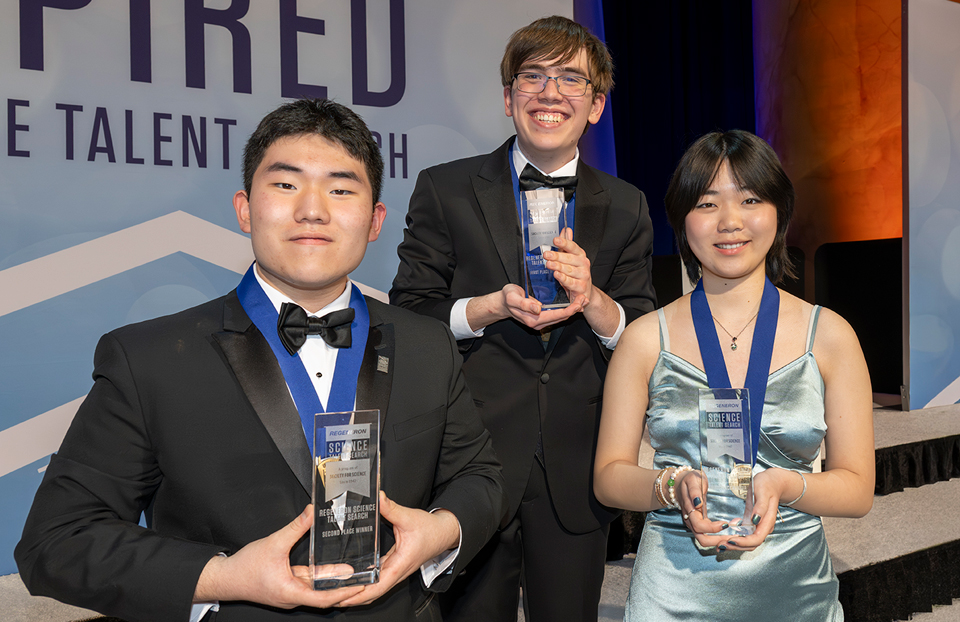
The Top Ten 2026 Regeneron STS Winners
First Place: Connor Hill
Award Value: $250,000
City, State: Port Matilda, PA
Connor Hill, 17, of Port Matilda, created a full list of the mathematical shapes called “noble polyhedra” for his Regeneron Science Talent Search mathematics project. A polyhedron is a shape with flat sides and straight edges, such as a cube or a pyramid. In a noble polyhedron, all the faces are the same shape, and the angles at each corner are the same. By 2020, mathematicians knew of two infinite families of noble polyhedra and 61 isolated examples. However, they thought there were probably more noble polyhedra out there. In his project, Connor wrote a computer program to work through all the conceivable ways to build a noble polyhedron. He concluded that in addition to the two known infinite families, there are 146 noble polyhedra. Connor hopes that his program can be used to find other shapes, such as those made by interconnecting multiple polyhedra.
Second Place: Edward Kang
Award Value: $175,000
City, State: Hackensack, NJ
Edward Kang, 17, of Hackensack, developed AI models to screen for neurodevelopmental disorders using images of the eye for his Regeneron Science Talent Search neuroscience project. Getting a diagnosis for autism or attention-deficit/hyperactivity disorder can take months or years. Because the eye and brain develop from the same tissues, previous studies have shown that these conditions are linked to differences in the retina, the light-sensing tissue at the back of the eye. In his project, Edward used retinal images from a large public dataset to train AI models to find these differences. He improved the models by combining several approaches and studying what influenced their predictions. He tested the models as a screening tool and built a prototype, called RetinaMind, to show how it might work. He also created a retinal cell model to study gene changes that may help explain the differences and validated his results in a second cell model.
Third Place: Iris Shen
Award Value: $150,000
City, State: The Woodlands, TX
Iris Shen, 17, of The Woodlands, studied whether a marine clam with a naturally occurring blood cancer can be used to study human leukemia drugs for her Regeneron Science Talent Search animal sciences project. Animal models of cancer are costly, time-intensive and have ethical implications. In her project, Iris tested how clams respond to a potential cancer drug. She found that in clams, the drug had the same effect it does in human cells: fewer cancer cells stayed alive, tumors had a smaller proportion of cancer cells and the cells’ fat levels changed in similar ways. In a second experiment, Iris tested a mixture of two other compounds in clams. She found that it slowed tumor growth without negative effects on non-tumor cells. Iris’s clam model could help make early drug discovery more cost-effective and ethical.
Fourth Place: Rachel Chen
Award Value: $100,000
City, State: Los Angeles, CA
Rachel Chen, 18, of Los Angeles, developed a concrete, visual way to describe quantum physics systems for her Regeneron Science Talent Search mathematics project. Since quantum particles interact with their environment in complex ways, it is hard to describe these systems mathematically. A 1997 paper showed that part of the quantum system could be described using simple point-and-curve graphics called Temperley-Lieb diagrams. Researchers across mathematics and physics use these diagrams as an intuitive tool for understanding phase transitions, mathematical knots and other concepts. Rachel expanded on the 1997 work, using Temperley-Lieb diagrams to describe how an entire system of quantum particles acts under the influence of a magnetic field. This may be useful as an intuitive framework for researchers to understand the structure and connections among different quantum-mechanical states. She also used her results to understand alternative ways of working with the quantum system.
Fifth Place: Jerry Xu
Award Value: $90,000
City, State: Lexington, MA
Jerry Xu, 17, of Lexington, developed an AI model to rapidly compare the structures of proteins and amino acids for his Regeneron Science Talent Search computational biology and bioinformatics project. Molecular biologists can learn a lot from a molecule’s structure, but identifying all the parts of that structure — as well as their purposes — is a massive computational task. Current methods either focus on overall structural comparisons, potentially missing key details in protein shape, or are too slow to handle massive databases of molecules. In his project, Jerry found that structural information could be compressed into numerical strings for more efficient comparison without the loss of important features. His model could help biologists to learn about the function of currently unknown parts of proteins.
Sixth Place: Leanne Fan
Award Value: $80,000
City, State: San Diego, CA
Leanne Fan, 18, of San Diego, studied how to better heal wounds in microgravity for her Regeneron Science Talent Search medicine and health project. Wounds heal slowly in space due to the absence of mechanical loading, or gravity’s pull on tissues. For her project, Leanne built a continuously rotating device to simulate microgravity. The device rotates along two axes, preventing gravity from acting on the wound sample in just one direction. Leanne then treated injured flatworms in this simulated microgravity with 660-nanometer red light. She saw that treatment sped up tissue regeneration by 95.2%. She then tested red light in wound models using human cells and found that it sped up cell migration during wound closure by 29.4% in normal gravity conditions. Leanne’s work could lead to new ways to treat injuries in space, as well as in remote places, during natural disasters, or in other situations with limited access to care.
Seventh Place: Claire Jiang
Award Value: $70,000
City, State: Wyckoff, NJ
Claire Jiang, 18, of Wyckoff, developed a cellular model of juvenile idiopathic arthritis (JIA) for her Regeneron Science Talent Search medicine and health project. JIA is a chronic disease in children that causes joint pain and damage, but is not well understood. Claire, who was diagnosed with JIA in third grade, aimed to build a model of fibroblast-like synoviocytes (FLS). FLS cells in the joints are affected by JIA, so a model to study them in the lab could help scientists learn about the disease. After reviewing past research, Claire chose SW982, a cell line used to study rheumatoid arthritis. She treated SW982 cells with bone morphogenetic protein 4 (BMP4), a protein linked to JIA-related joint damage. She found that cells treated with BMP4 behaved like JIA FLS in their growth patterns and gene expression. She believes this model can help researchers better study JIA and find new treatments.
Eighth Place: Leon Wang
Award Value: $60,000
City, State: Stamford, CT
Leon Wang, 17, of Stamford, identified FDA-approved drugs that might be helpful against Alzheimer’s disease for his Regeneron Science Talent Search neuroscience project. First, Leon studied cellular changes associated with a gene variant known as APOE4. APOE4 is the greatest known genetic risk factor for Alzheimer’s, but researchers don’t know why. Using publicly available data, Leon confirmed previous findings that APOE4 carriers had a more active pathway for the signaling protein TGFβ in the cells that line blood vessels in the brain. Leon studied lab-grown versions of those cells and found that higher TGFβ activity damaged them. From prior studies, he identified two FDA-approved drugs known to turn down TGFβ, nintedanib and pirfenidone, treatments for lung scarring. In the cell model, both drugs reduced signs of damage from overactive TGFβ. Repurposing existing drugs is safer and cheaper than creating new ones. These and other drugs targeting TGFβ may one day help treat Alzheimer’s.
Ninth Place: Jonathan Du
Award Value: $50,000
City, State: Mountain View, CA
Jonathan Du, 18, of Mountain View, explored how factorization works in different mathematical spaces for a Regeneron Science Talent Search mathematics project. Factorization is breaking numbers, polynomials or other mathematical objects into a product of simpler parts: factors. Factorization has enthralled mathematicians since antiquity, and it now underpins the encryption of most information on the internet. Jonathan’s project investigated a new idea called the unrestricted finite factorization property and showed how it relates to other types of factorization. Whole numbers have the simplest factorizations, with a specific set of factors associated with each number. But in more complicated algebraic systems, some elements have several factorizations while others may not factor at all. Jonathan’s project studies systems in which the elements that do factor only do so in a limited number of ways. This work could help mathematicians understand how strange multiplication can get.
Tenth Place: Seth Nabat
Award Value: $40,000
City, State: Winnetka, CA
Seth Jacob Nabat, 18, of Winnetka, developed a machine learning program to make sense of the results of particle collisions for his Regeneron Science Talent Search physics project. Physicists use computer models to study high-energy particle collisions. When these programs expect symmetrical results, it saves computing time and energy, but can lead to measurement errors being doubled. In his project, Seth designed a three-part system to avoid this confusion. The first network is the one that “knows” about symmetry and uses it to find the quickest way to the approximate results of collisions. The second, unconstrained network catches camera and measurement errors, and the third network finds patterns in those errors. He found that, in tests, his combined model was able to navigate the imperfect data without losing the efficiency advantage. His model lets researchers look directly at what “breaks” symmetry, a fundamental problem in physics, especially quantum field theory.