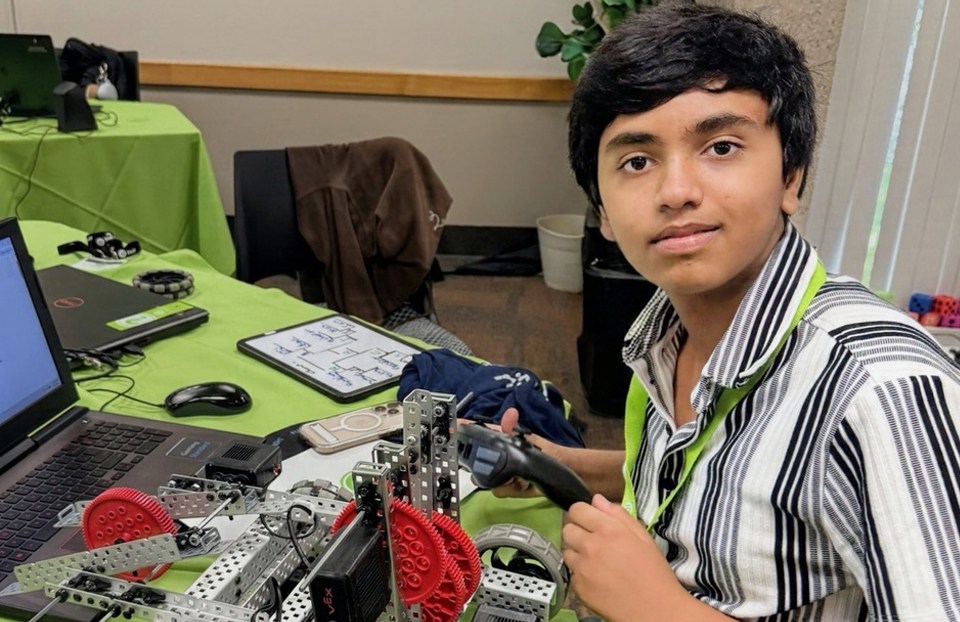
Thermo Fisher JIC 2026 Finals Week opens with the Project Showcase
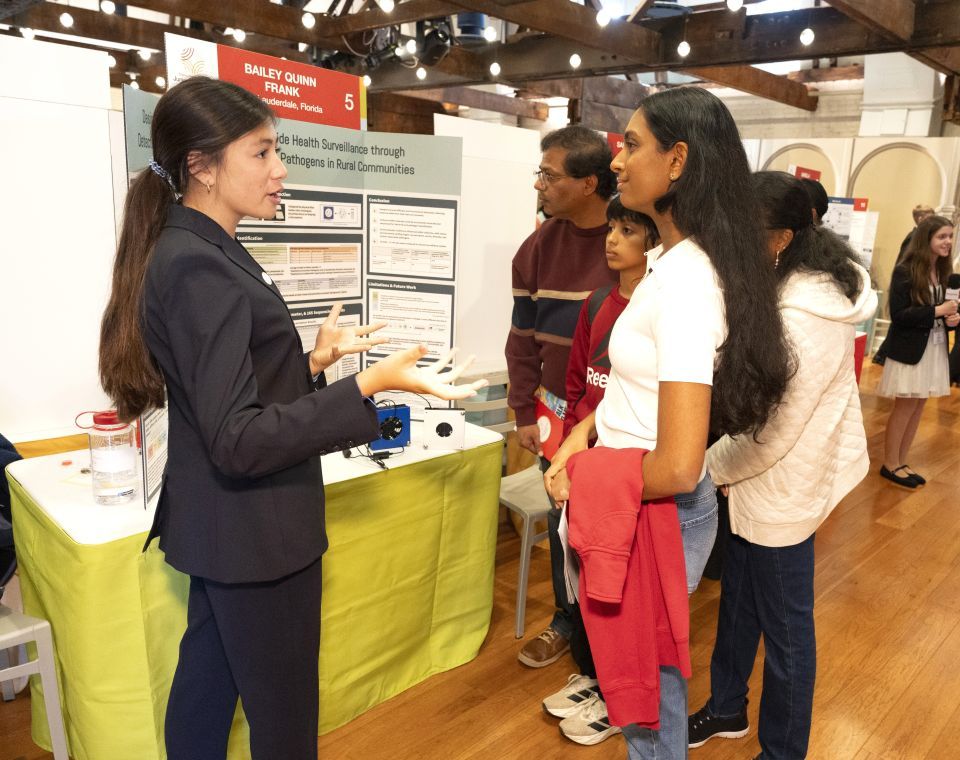
The Thermo Fisher Scientific Junior Innovators Challenge Finals Week (Thermo Fisher JIC) is underway in Washington, D.C.
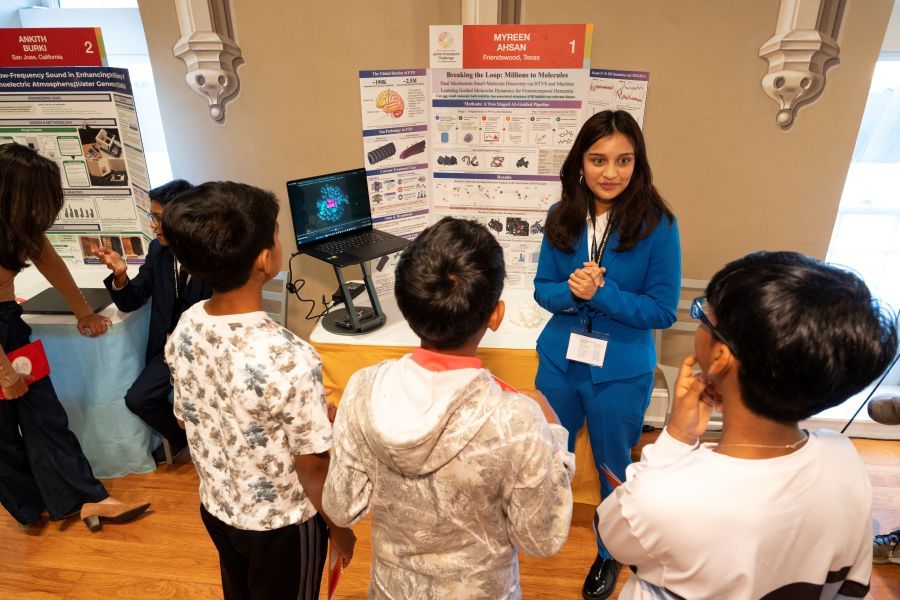
After orientation, icebreakers and project judging, the top 30 finalists shared their research and hard work with the public at Planet Word Museum this past Saturday. The room buzzed with guests of all ages. Finalists explained the questions inspiring their projects, how they conducted their research and what they discovered, while sharing what they were most excited about for the week ahead.
At the exhibition, we caught up with six finalists and learned more about their research and experience so far.
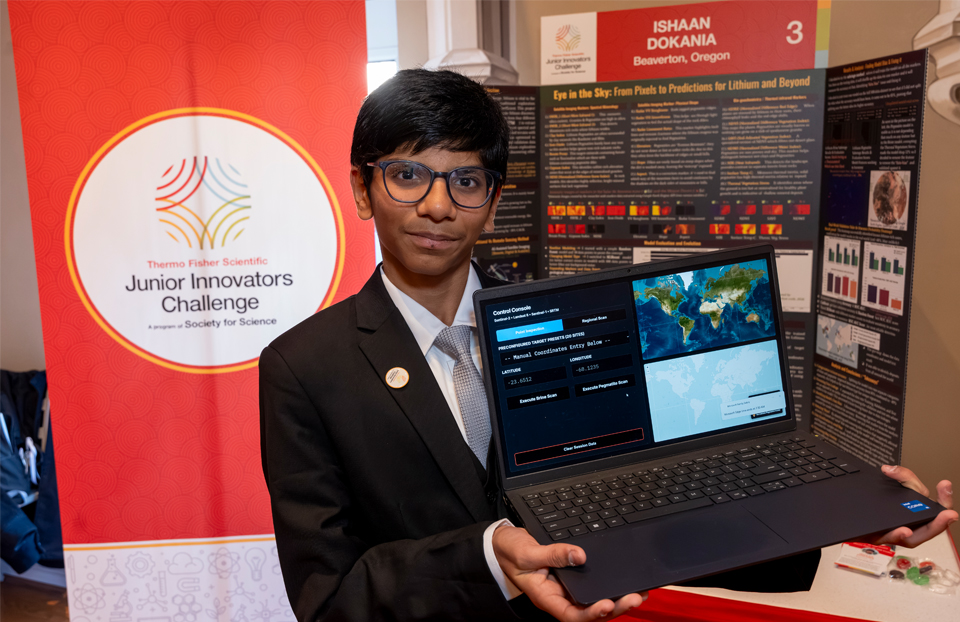
Ishaan Dokania, 12, from Beaverton, Oregon, combined his interest in remote sensing, rocks and minerals for his project. He explored a better way to identify lithium deposits, explaining that current methods can damage the environment, be inefficient and come with high costs.
Ishaan trained a machine learning model on satellite imagery and mineral data, tested several algorithms and even solved a noise issue that affected his model’s accuracy. A test called Leave One Feature Out helped him detect lithium deposits with 89% accuracy.
“Being here is just a really nice experience, and a lot of people and their projects are cool,” Ishaan says. “For example, there’s another finalist here and we both used the same machine learning algorithm in our research, but his model is trained to predict on something else and now we’re talking about different types of machine learning.”
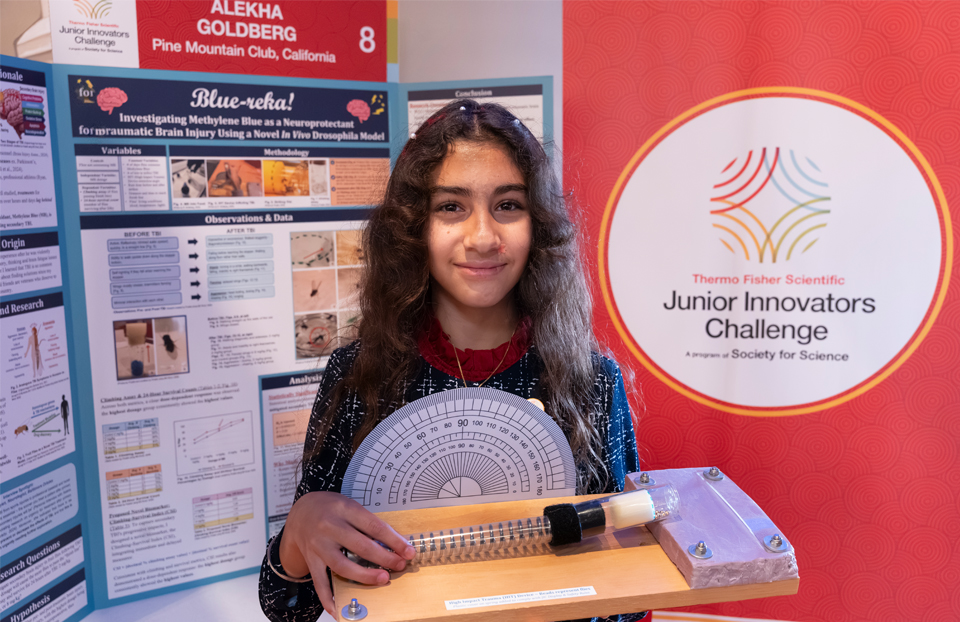
Alekha Goldberg, 13, from Pine Mountain Club, California, investigated if methylene blue could help reduce the effects of secondary traumatic brain injury. She used fruit flies to test her hypothesis by having one control group and four groups that received different doses of the medication. She used a High-Impact Trauma device to strike vials of flies against a pad three times, mimicking impacts such as those in a car accident. Then she tested the flies’ abilities in a climbing assay, tracking how far they could climb and how many survived. The results showed that flies treated with methylene blue climbed higher after injury; those given the highest dose climbed the highest and were most likely to survive for 24 hours.
“There are a lot of things that surprised me about my project,” Alekha says. “One of them being how similar the reactions were in both flies and humans. For example, when humans get traumatic brain injury, they might do a thing called ‘fencing,’ which is basically when they’re on their ground and lying on their back; they will stick one of their arms out and have a clenched fist. That is fencing. The equivalent to fruit flies would be when they have their wings sticking straight up, which is their version of fencing.”
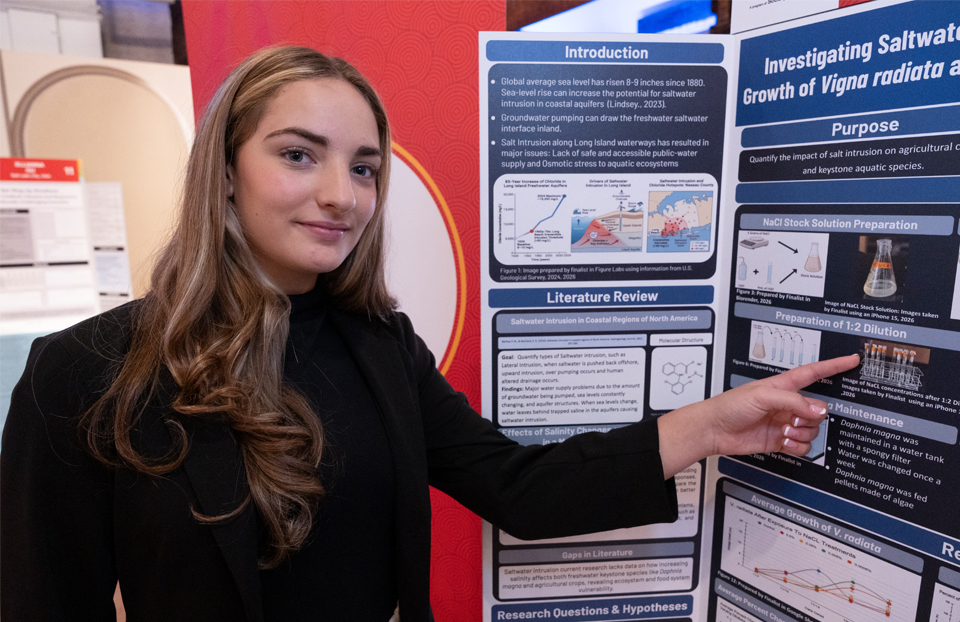
Hanna Ryan Heitefuss, 14, of Lido Beach, New York, drew inspiration for her research from her local beach. She is concerned about rising water levels and increased flooding, especially saltwater intrusion into freshwater areas near her home.
Hanna investigated how saltwater concentrations could affect plant growth and freshwater organisms. She tested mung bean seeds and Daphnia magna, a tiny freshwater crustacean, in five different saltwater concentrations. The mung beans showed no differences in germination, but higher salt concentrations caused the Daphnia’s heart rates to increase, suggesting the salt stressed them.
“What surprised me was that in the mung bean seeds (Vigna radiata), a lower concentration of NaCl (sodium chloride) actually benefits their growth,” Hanna says. “So, if you are ever planning to use salt to water your plants, it would have to be an extremely low concentration, really close to my control.”
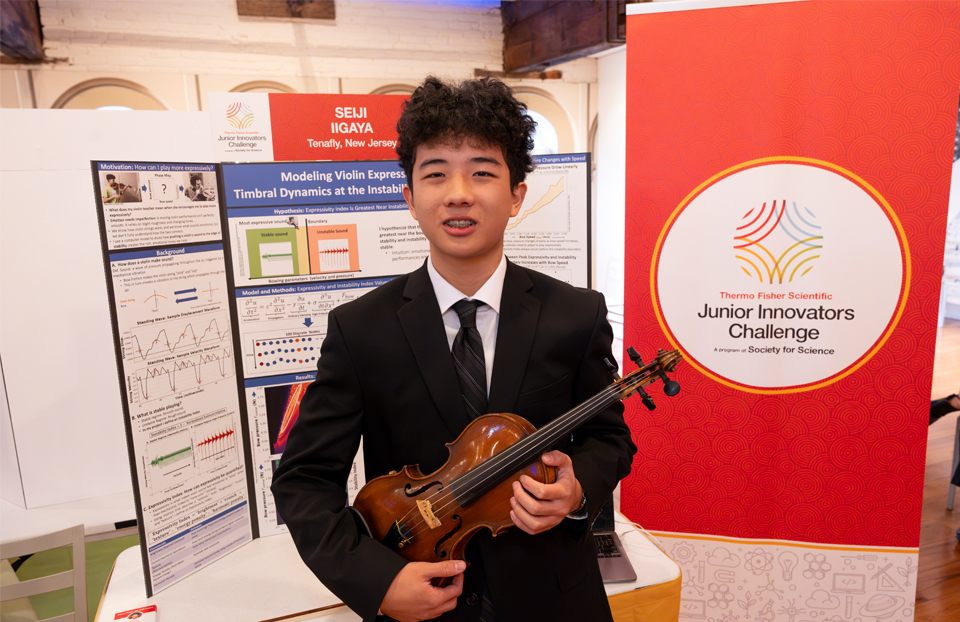
Seiji Iigaya, 14, from Tenafly, New Jersey, brought together music and science with his project. Wanting to play more expressively, he developed a mathematical model to find which bow speed and pressure produced the most expressive sound.
Using Python, he simulated a violin string and divided it into 100 potential points of interaction between the bow and string. He tested a range of bow speeds and pressures.
“I was very happy I was able to prove this quantitatively,” Seiji says. “Something else I found in my research was that there’s a slight buffer zone where you can play very expressively, but the sound is still not unstable. There’s a slight gap, and I found that this increases with bow speed, which was something very interesting since that means that violinists need to adapt dynamically in order to play with a lot of expression.”
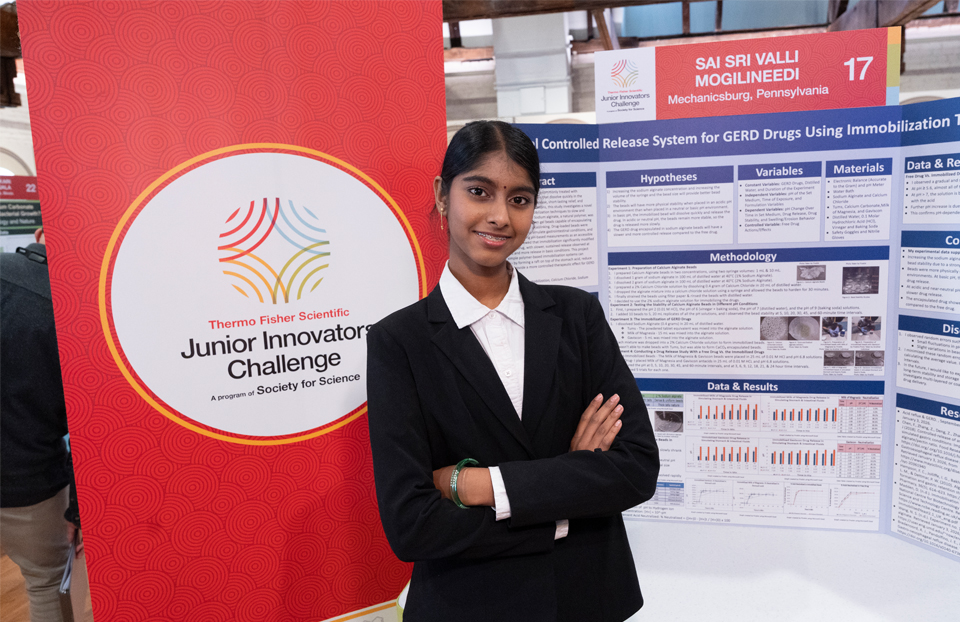
Sai Sri Valli Mogilineedi, 13, of Mechanicsburg, Pennsylvania, looked at longer-lasting relief for those struggling with gastroesophageal reflux disease (GERD). Antacids dissolve quickly, providing only short-term relief.
In her project, she crushed up antacid tablets, which contain calcium carbonate, and dissolved them into water at two different concentrations. She did the same for sodium alginate, a substance derived from algae that helps molecules form into beads. In tests, the beads released calcium carbonate more slowly in an acidic solution similar to stomach acid than in a basic solution. She hopes a more controlled release of the drug will provide long-lasting relief.
“I’m definitely looking forward to the challenges and the project showcase,” Sai Sri Valli says. “I’m excited to talk to other people and share my findings and see what questions they may have.”
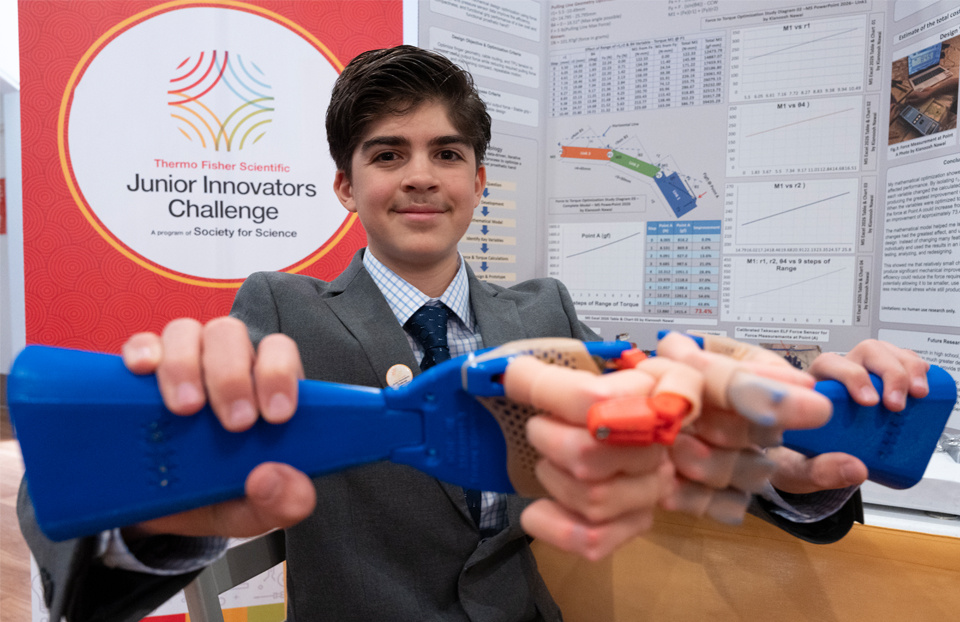
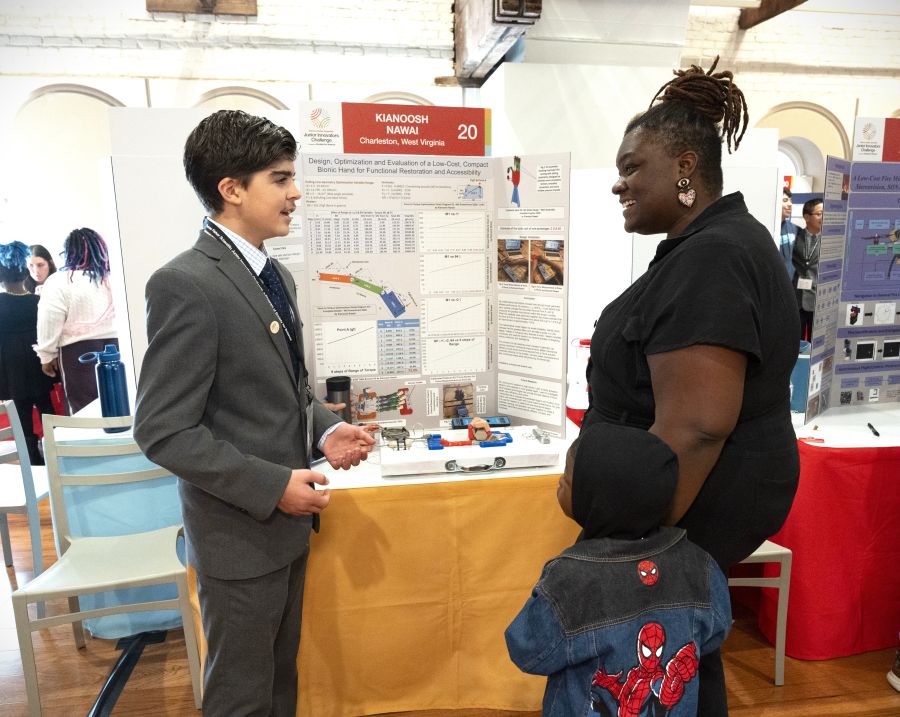
Kianoosh Nawai, 14, of Charleston, West Virginia, explored a more affordable design for a prosthetic hand after seeing how assistive devices can help people with disabilities.
After studying how the human hand works, particularly how tendons control movement, he used a 3D printer to make the prosthetic hand. He used pulling lines as his “tendons” while thermoplastic polyurethane provided resistance and allowed him to control the motion. He tested different versions, measuring grip strength and the force needed to flex the fingers.
Kianoosh’s final version could grip objects consistently. He hopes to eventually add a power source so the hand can generate the force it needs.
“I’m looking forward to being happy this week,” Kianoosh says. “Being around people and having a very strong bond with my team is exciting and it’s an honor to be here.”
Stay tuned for the Thermo Fisher JIC winners’ announcement Tuesday evening, Oct. 27, 2026. Learn more about all the finalists and their projects here.