Lemelson Foundation, Young & Amazing
The robot gardener of the future
Annually for three
years, The Lemelson Foundation
will give $100 awards to outstanding inventors in up to 270 Society Affiliate
Fairs with middle school participants around the country. The prize was
specially created to reward young inventors whose projects exemplify the ideals
of inventive thinking by identifying a challenge in their community and
creating a solution that will improve lives.
Meet Ta’Janae Clinton, a high school freshman from Eufaula, Alabama,
who recently won the Lemelson
Early Inventor Prize at the Alabama Science and Engineering Fair .
Ta’Janae’s invention, ELECTRA, which stands for educated, earning, efficient,
cunning, technical robot assistant, is a robot that can plant gardens!
During her time volunteering in a nursing home, Ta’Janae witnessed residents
struggle to perform the manual labor required to plant seeds and tend to their
gardens. Inspired to help and use her STEM skills, Ta’Janae invented a motorized
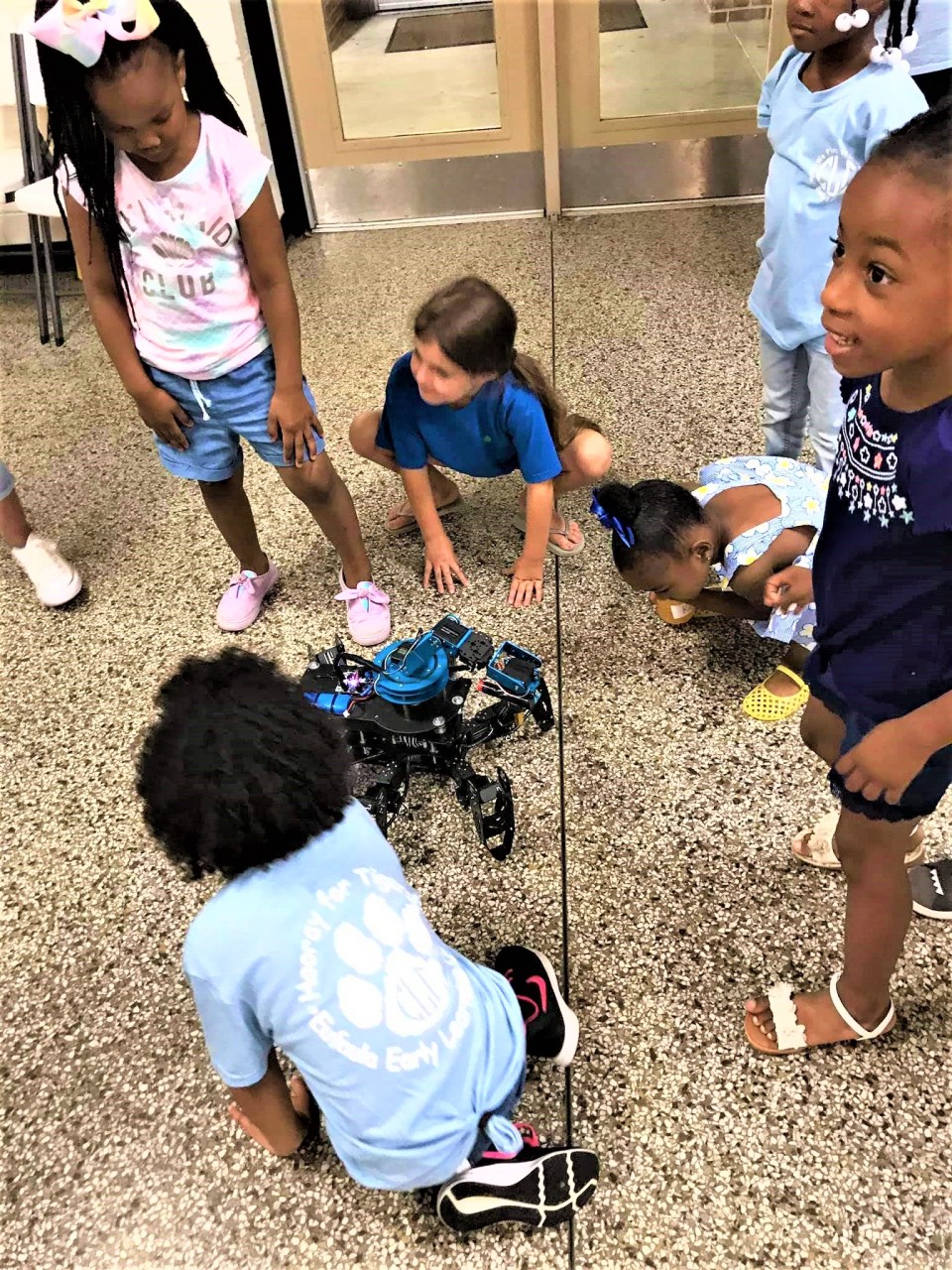
robot, to assist with planting seeds of all types. Looking much like a black
spider bot, ELECTRA is powered by an Arduino board, has a motorized
drill and four motorized legs. She’s capable of running for three hours per battery
charge. ELECTRA can dance, say hello and perform the steps necessary in
planting a garden without becoming fatigued. She is built to work under extreme
heat conditions.
Ta’Janae tested the robot using three main criteria:
- ELECTRA’s ability to drill a hole to drop seeds
into - Her ability to move into a position to drop
seeds into the holes - Her ability to drop the seeds into the holes
successfully
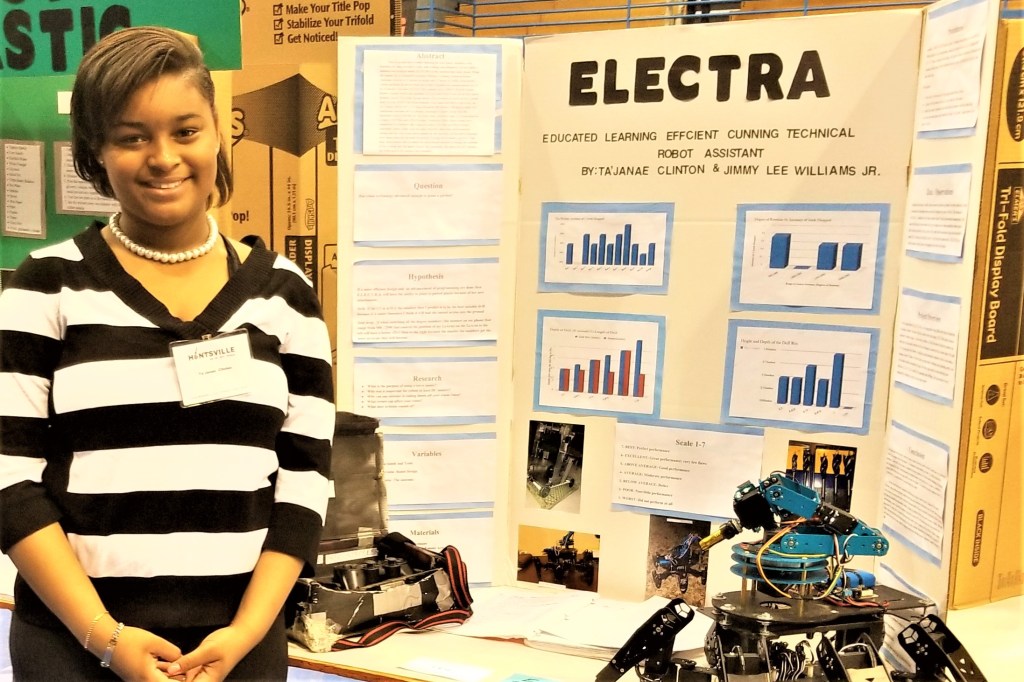
PHOTO COURTESY OF TA’JANAE CLINTON.
After ELECTRA was booted up, Ta’Janae measured the depth of
the holes to see if it changed with the length of each drill bit. From that information,
she found that the .5, .75 and 1-inch width drill bits worked best. For the
second test, Ta’Janae had to figure out the best angle for ELECTRA’s arm to be
in when dropping seeds into the holes. ELECTRA’s arm could bend at four angles
using the Arduino board—0°, 90°, 180° and 360°. Ta’Janae tested each angle position
10 times to determine which one drilled the best while transitioning to seed
dropping.
In the third test, Ta’Janae tested ELECTRA’s ability to drop
seeds into a hole successfully. Ta’Janae ran the trials by inserting five
radish seeds into ELECTRA’s custom-built seed holder and found that all the
seeds fell into the hole, depending on the optimal angle. ELECTRA passed all
three tests with flying colors.
Ta’Janae’s project was aided by the mentorship of Jimmy Lee
Williams Jr., a retired employee of Alabama Power who is now a robotics consultant.
Jimmy helped Ta’Janae bring her vision to life by constructing the robot’s arms.
He also introduced Ta’Janae to coding and software that could be used to
control her robot. Ta’Janae was also inspired by the women engineers she met
during a summer program at the University of Alabama.
“I attended the University of Alabama’s AAUW TECH TREK
summer program in 2018. There, I was given the opportunity to interact with
and question a panel of women who held STEM careers,” said Ta’Janae. “We had
the opportunity to ask the ladies questions about their paths and why they
chose them. After hearing the women speak, I awakened to my own passion for
science and robotics.”
Ta’Janae hopes to become an engineer one day and establish her own robot
manufacturing company.