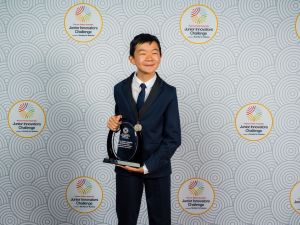
Five Questions with Miles Wu, the top winner of the 2025 Thermo Fisher JIC
From collaborating in team challenges in Washington, D.C., to imagining a future spent studying with leading origami engineers around the world, Miles Wu approaches science with both authentic curiosity and humility. The top winner of the $25,000 award in the Thermo Fisher Scientific Junior Innovators Challenge (Thermo Fisher JIC) last year, Miles’ work drawn national attention. His work has been written about in Business Insider, Smithsonian Magazine, Forbes, and his achievements have even been celebrated on The Kelly Clarkson Show.
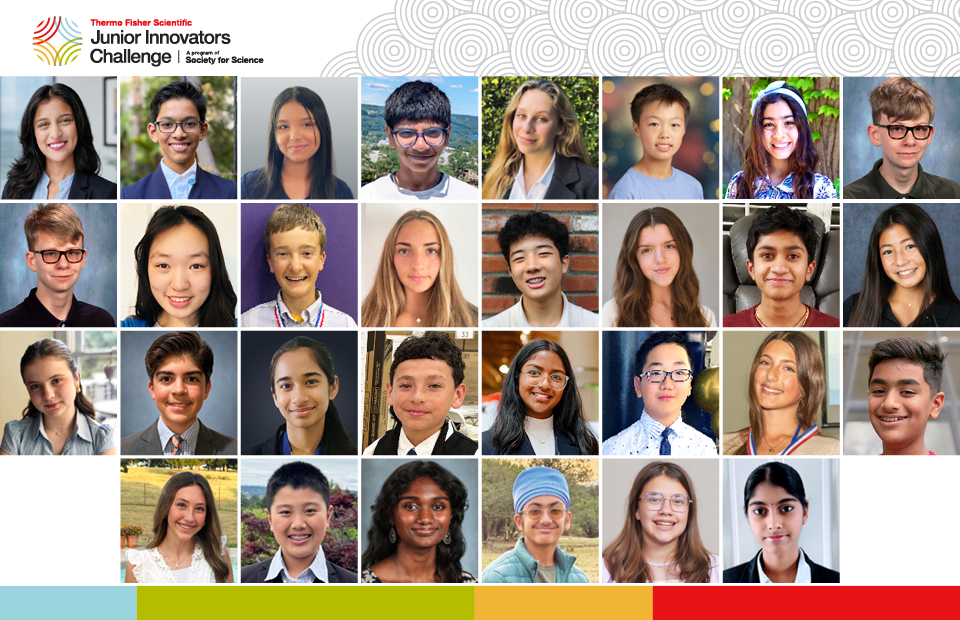
Miles says his experience at finals week with his fellow 29 finalists surprised him. What he imagined would be an intense, high-stakes competition week turned out to be collaborative, supportive and fun-filled experiences comprised of late-night conversations, games and shared problem-solving. Whether building Rube Goldberg machines, taking on biomimicry challenges, or coding under pressure, Miles found himself energized by the chance to get creative alongside peers who were just as passionate about science as he is.
That spirit of collaboration he experienced also adds to his perspective on science research. For Miles, science is an ongoing process, where intermediate ideas, failures and explorations are just as valuable as final outcomes. It’s a mindset he hopes more adults recognize when talking to young scientists.
We asked Miles to reflect on his experience, his research and what he sees next in his path.
What’s something another finalist said or did that stuck with you?
One thing that stuck with me was how kind and cooperative my teammates (Arya, Brady, Camila and Evann) were during our group challenges. I was grateful to be in a group where each member lacked ego and competitiveness and helped each other. I appreciated how everyone was able to work calmly and collaboratively under pressure in timed challenges. Working with my fellow finalists reminded me that being a successful team isn’t about individual expertise or skill, but about humility, listening to your teammates, and letting everyone shine.
During finals week, when did you feel most like yourself?
I felt most in my element during the team challenges. I really enjoy problem-solving and building and making things, so the opportunity to work with other students just as interested in science and engineering made team challenges the most fun part of finals week. I loved being able to come up with creative solutions with my teammates, and to learn more about certain topics.
If you had unlimited time and resources, how would you take your idea further?
I would want to spend a year studying with the researchers on the cutting edge of origami engineering to deepen my understanding in the field. First, I might fly to Italy and study in Diego Misseroni’s lab, to learn more about origami metamaterials and structures and how to test them. Then I would spend a semester learning from other origami scientists and engineers, for example studying with Katia Bertoldi, who has worked on origami shelters, or taking Glaucio Paulino’s class on Origami Engineering at Princeton. It would also be an amazing opportunity to learn origami as an art form from the masters: Robert Lang for mathematical approaches to design, Hoang Tien Quyet for wetfolding and shaping, and Satoshi Kamiya for sheer complexity.
What’s a question you wish adults asked you more often about your research?
A lot of times when adults ask students about their research, they assume that the goal must be a tangible product or a patented design. In reality, most student science projects will not directly translate to a perfectly polished real-life product. Intermediary projects, explorations and steppingstones are just as valuable contributions to the field of science. I wish adults asked questions with this understanding that no single science project can ever be fully complete, but there is always more to learn and explore.
What would you say to a student who’s unsure if their project is “good enough” to apply?
“Go for it! You never know. Even a “simple” project can go further than you think. By filling out your application you will gain a better understanding of your own project and your scientific goals and obtain valuable experience for future research. Filling out the application takes time and is a lot of work, but it pushed me to clarify my ideas and deepened my understanding of the scientific method.”
Applications for the Thermo Fisher JIC are now open now. Deadline is June 10, 2026 at 8 p.m. ET. Open your application today!