A man for all markets returns to the Regeneron Science Talent Search
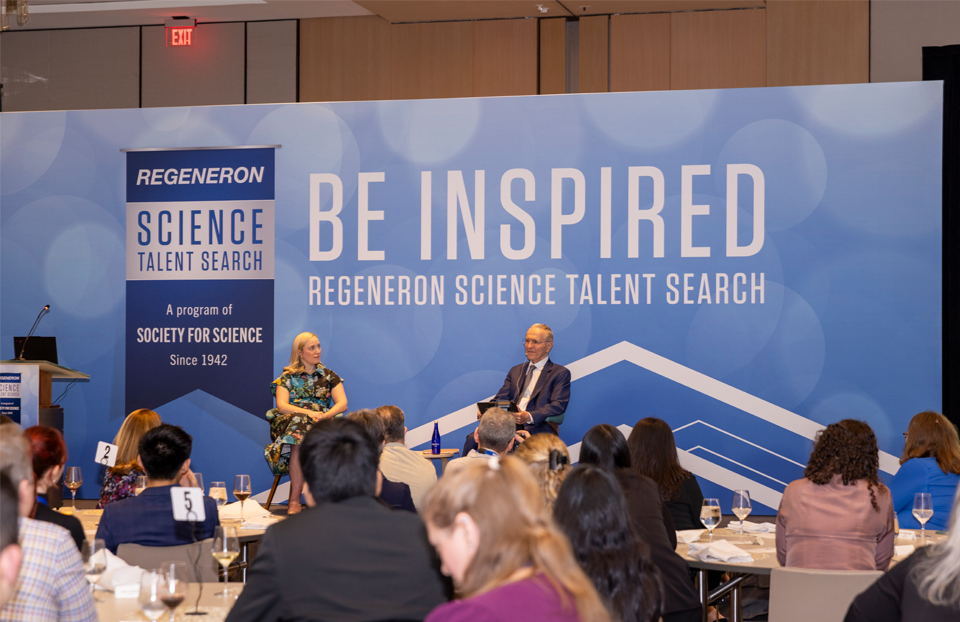
Seventy-five years after receiving a telegram that would change his life, Edward Thorp (STS 1949) returned to the Science Talent Search (STS), not as a finalist from a struggling Los Angeles high school, but as a celebrated mathematician, bestselling author and pioneer of modern quantitative finance. During a conversation with the Director of the Regeneron STS, Allie Stifel, Thorp shared stories about blackjack, mathematics and the joy of problem solving.
Growing up during the Great Depression and World War II, Thorp attended what he described as one of the worst high schools in the Los Angeles school system, a place where shop classes outnumbered academic ones. He taught himself science through library books, funded experiments by delivering newspapers at two in the morning and received a subscription to Science Newsletter (now Science News) from a retired engineer neighbor.
It was in Science Newsletter that Thorp discovered the Science Talent Search. “Nobody in my high school goes to college, but maybe I can,” he recalled thinking.
Thorp submitted an essay titled Some Original Calculations in his Science Talent Search application and promptly forgot about it until he found a telegram on his doorstep. “It couldn’t be for me. I’d never seen a telegram,” he said. That telegram sent him to Washington, D.C., where he met President Harry Truman, heard from Nobel Prize-winning physicist I.I. Rabi, toured a 60-inch cyclotron and won $100.
Thorp went on to earn a Ph.D. in mathematics from UCLA, teach at MIT and UC Irvine, and authored six books, including Beat the Dealer, the first scientific system ever devised for a major casino gambling game, which transformed how the world plays blackjack.
Thorp explained that his blackjack story began almost by accident. Just before Thorp and his wife headed to Las Vegas, a colleague mentioned a strategy for the game. Intrigued, Thorp dug up a research paper showing that optimal play could reduce the house edge from 2% to about two-tenths of a percent. Armed with just $10 and a small reference card outlining the strategy, he sat down at a blackjack table. The other players laughed at him, convinced he was a fool. Then, he drew a seven-card 21, a rare and highly favorable hand.

That moment sent Thorp back to the academic literature with fresh eyes. “I knew how to beat this game,” he said, describing the mathematical insight that struck him almost immediately upon re-reading the original paper. The key was understanding what happens to the odds as cards are removed from the deck, which is something no one had systematically studied.
Thorp was teaching at MIT at the time. He spent his days teaching and his nights running calculations on a Monroe electric calculator, only to estimate it would take him 10,000 years to finish by hand.
Thorp then taught himself Fortran, a programming language for the IBM 704, and after about six months of trial and error began getting results. The system worked.
One of the unexpected benefits of cracking the problem, Thorp noted, was that he had never taken a course in probability before tackling it. He wasn’t burdened by the widespread belief that casino games simply couldn’t be beaten. “One of the benefits of being ignorant,” he said.
Later, when he first began investing in the stock market Thorp knew nothing about it. “I made terrible investment mistakes,” he said. “After I made many mistakes, I sat down and read book after book after book.” Thorp then received a financial newsletter in the mail called the RHM Warrant Survey. Warrants are the forerunner of what we call options today, and Thorp realized he could “mathematicize” warrants. This discovery led to Thorp’s follow-up book, Beat the Market, which, in turn, led him to establish the first market-neutral hedge fund in 1969.
Inspired by Thorp’s story of curiosity, persistence and mathematical thinking? The Regeneron Science Talent Search 2027 application is now open and will be accepted through 8 p.m. ET on Thursday, November 5, 2026. Students with original research projects are encouraged to apply and take the next step in their own scientific journey.