Science News Learning, STEM Outreach
Bringing science to the classroom: Science News in High Schools
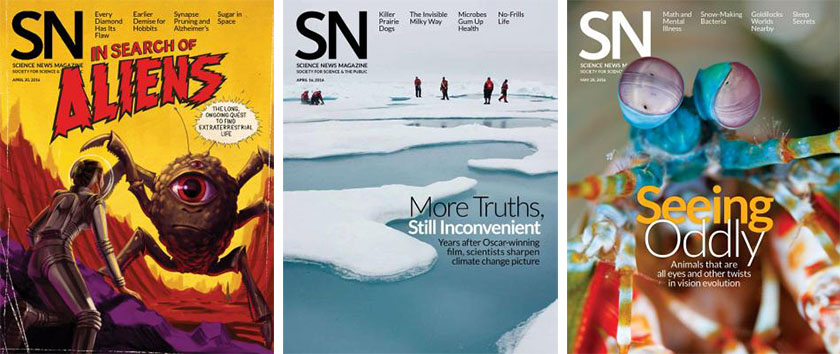
Science News in High Schools is a unique program for teachers and students. It keeps educators up-to-date on the latest science through expert journalism. The magazine serves as a great resource for research and discussion. And the program comes with an Educator Guide to quickly integrate the magazine into the life of the classroom.
President & CEO of the Society and publisher of Science News Maya Ajmera thought of the program after six months of working at the Society.
Help every high school in America, and beyond, receive Science News. Become a sponsor today!
“I already knew teachers who bought the magazine personally and used it in their classrooms,” said Maya. “I thought why not have a way for them to get the magazine through Science News in High Schools. But more broadly, every teacher in America should have this resource.”
Science News in High Schools brings the curriculum to life.
–Michele Glidden, Chief Program Officer
Bringing curriculum to life
“The program bridges the gap of improving scientific literacy among our younger audiences,” said Michele Glidden, the Society’s Chief Program Officer.
The staff at Science News does science journalism best. The independent magazine, published since 1922, has a staff of beat reporters who focus solely on specialized topics of science.
Inside every issue of Science News are features that focus on recent reports, studies, findings, trends, and current news that science can inform or the science behind news. Examples of recent stories include what science can conclude about gun violence and what drives someone to become a terrorist.
The more educated a teacher is about current science topics, the better able they are to teach science.
–Elizabeth Quill, Enterprise Editor Science News
“A lot of entities sell science stories,” Elizabeth said. “We’re bringing science stories that are legitimate, important, interesting, and valid. We’re not chasing the hype.”
Science is an ever-evolving endeavor. Some teachers use outdated textbooks and miss the latest developments.
Putting Science News in high schools provides teachers the opportunity to remain updated on all fields of scientific inquiry. The magazine and Educator Guides help teachers gain a better understanding of science as a process.
The magazine supplements what teachers learned about science a decade or more ago, Elizabeth said.
The issue with textbooks is that upon printing, it’s old. Science News offers current journalism.
–Michele Glidden
“One of the issues with textbooks is that upon printing, it’s old,” Michele said. “The idea of providing a resource with current information, and an instrument to help teach it, is an extra resource for teachers. It brings the curriculum to life.”
Taking the load off teacher’s plates
Teachers are extremely busy. The Educator Guides provide ready-to-teach activities, experiments, and discussion questions that can be incorporated into lessons for hardworking teachers.
The guides offer a variety of ways to use Science News to enhance teaching, including: discussion questions, experiments, demonstrations, and writing activities. The guides are aligned with Next Generation Science Standards and Common Core.
“Science News in High Schools creates a lifetime learning opportunity,” Michele said. “A resource like Science News is only enhanced by providing additional resources for how it can be implemented in the classroom.”
Bring Science News in High Schools to your school.
So far, Science News staff have produced the guides with the help of curriculum writers.
“The more educated a teacher is about what’s happening in the field of science, the better able they are to teach science,” said Elizabeth.
A model school in the program wouldn’t allow the 10 copies of the magazine to gather dust in a corner of the loading dock.
“We want the program to trickle down,” Michele said. “The whole school should have access to this resource, not just one classroom teacher or science class. It should be shared among colleagues, in libraries, on the school’s website.”
The future of Science News in schools
“I’d like to see every high school in America and the world have Science News through this program,” Maya said. “In the near future, I would love to see every participant’s high school at Intel ISEF get it too.”
I’d like to see every high school in America and the world have Science News.
–Maya Ajmera, President & CEO
Many areas of high school education could be enhanced by an interaction with Science News. “The journalism, the science content, the art,” Michele said. “Schools could make this resource a part of their weekly environment.”