Hope for the future: 2026 Regeneron ISEF finalists research solutions for the mental health crisis
Note: This blog includes references to depression and anxiety, which some readers may find difficult.
May is Mental Health Awareness Month, a time when conversations about mental health take place across the country. First observed in 1949, the month was created to help reduce the stigma surrounding mental health, according to the National Alliance on Mental Illness.
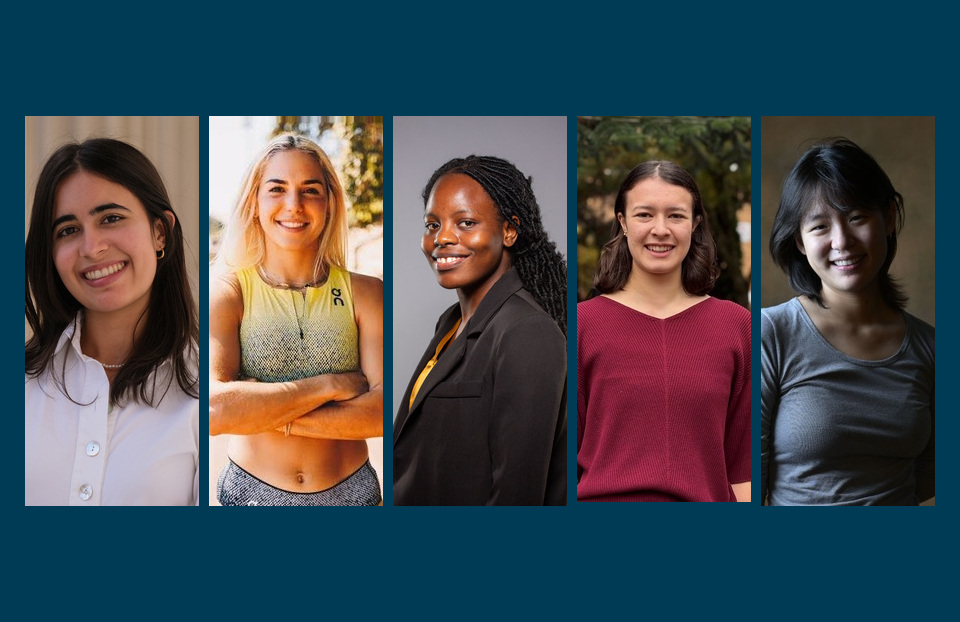
Read below about how several 2026 Regeneron ISEF finalists are using biochemistry, AI and medical research to help advance the conversations around improving mental health.
Angela Calvo-Chumbimuni (Oviedo, Florida)
In her biochemistry project, Angela Calvo-Chumbimuni, 17, of Oviedo, Florida, explored new approaches to detecting mental health challenges in patients. Depression, one of the most common conditions, is diagnosed primarily through clinical evaluation rather than objective lab testing. Her project focused on optimizing a novel electrochemical sensor and biosensor for detecting two mental health biomarkers: serotonin, (5-HT), which is associated with depression, and microRNAs, whose levels vary significantly in patients with suicidal ideation (for example, miRNA-1202). The sensor exhibited high selectivity when tested against a mismatched miRNA sequence, underscoring its specificity. Biological fluids including cerebrospinal fluid and blood serum were also evaluated to mimic real-world clinical conditions. Overall, the sensors showed strong reproducibility, selectivity and sensitivity. Angela also investigated simultaneous detection using different redox markers for the 4WJ biosensor. Future research could expand biomarkers in pathways affected by structural variants known to alter gene regulation in mental disorders.
Atiksh Bhan (Manassas, Virginia)
Atiksh Bhan of Manassas, Virginia, examined the connection between smartphone use and mental health, focusing on phubbing, the act of using a phone during face-to-face interactions. The behavior affects an estimated 75% of smartphone users and has been associated with depression, loneliness and relationship dissatisfaction. To better understand its impact, Atiksh conducted a randomized control trial involving 132 adults, 62% of whom were female, observing existing social groups in public spaces over sessions averaging 75 minutes.
This research demonstrates a novel contingency management approach to reducing phubbing, with potential applications in cafeterias, events and other social settings. Findings also suggest that interdependent group dynamics, not incentives alone, may play an important role in driving behavioral change.
Madelyn Donnelly and Ella Evora (Kingshill, U.S. Virgin Islands)
Ella Evora and Madelyn Donnely, both 17, of Kingshill, U.S. Virgin Islands, thought about mental health in space. Their project proposes an adaptive modular lunar habitat designed to support astronaut psychological well-being through integrated environmental design and AI-assisted monitoring. Mental health is a critical factor in mission success, particularly during long-duration space exploration, where astronauts face isolation, confinement, stress and delayed communication with Earth. The habitat features a scalable geometric structure that allows seamless expansion while reducing environmental monotony and promoting mental stimulation. Functional modules include living, research, communal and operational spaces. Supporting technologies, including motion sensors, circadian lighting that mimics Earth’s day-night cycle, and a wearable heart rate variability (HRV) wristband, monitor sleep, behavior and stress through a centralized dashboard. Together, these systems enable earlier detection of behavioral and emotional changes, offer a more proactive approach to mental health support than current methods.
Sara Hoti and Zackary Nizker (Peachtree City, Georgia)
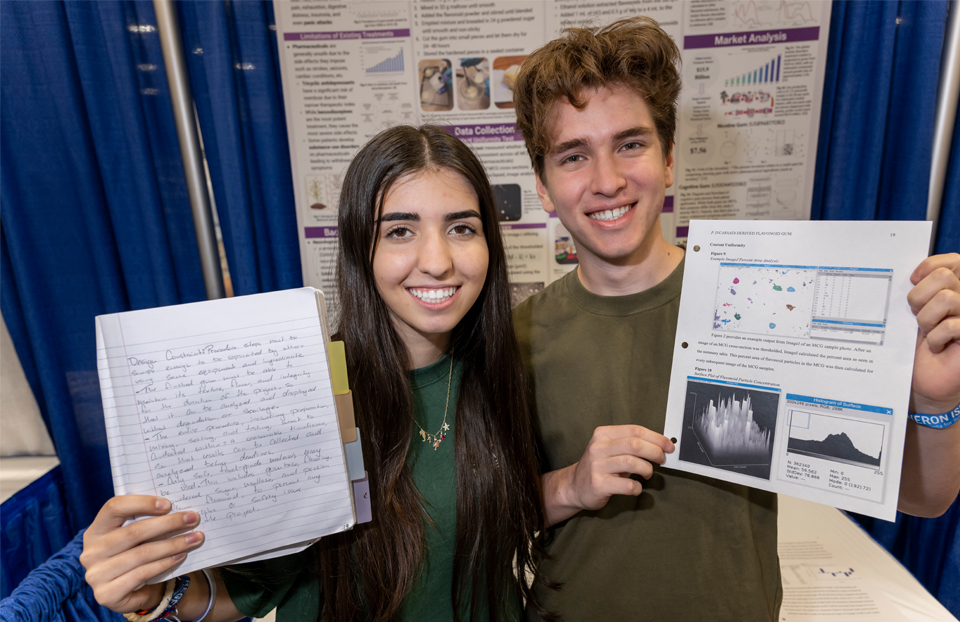
In their translational medical science project, Sara Hoti and Zackary Nizker, both 16, of Peachtree City, Georgia, created a medicated chewing gum to using passionflower as a potential treatment for generalized anxiety disorder, or GAD. Passionflower has long been studied for its calming properties, in part because it contains naturally occurring compounds called flavonoids, helping to regulate brain chemicals linked to anxiety. Their research explored whether these compounds could be successfully extracted from passionflower and incorporated into a medicated chewing gum while preserving their therapeutic effects. The results were statistically significant, suggesting the compounds remained effective in this form and pointing to a potentially accessible new approach to anxiety relief.
You can find more 2026 Regeneron ISEF finalists’ projects focused on mental illness and health here. Also, if you or someone you know is struggling and needs support, you can call NAMI at 1-800-950-6264 Monday through Friday from 10 a.m. to 10 p.m. EST or text 741-741 to connect with a crisis counselor, available 24/7. You can also call the 24/7 National Suicide Prevention Lifeline at 988 for help.