Meet five young scientists shaping the future on International Day of the Girl
Can AI help unveil overlooked cases of violence against women? Can locally sourced plant materials make menstrual products more sustainable and accessible for girls?
These are just a few of the questions young women investigated at this year’s Regeneron International Science and Engineering Fair (ISEF). In celebration of International Day of the Girl, a United Nations observance that recognizes the achievements and the challenges they face around the world, we are sharing a few young scientists making their mark in STEM.
Held in Phoenix, Ariz., the Regeneron ISEF welcomed more than 1,700 scientists from all over the world. The week culminated in awards recognizing their outstanding research. Among the awardees were girls whose projects proudly addressed pressing challenges in their own communities and beyond, inspiring the next generation of scientists.
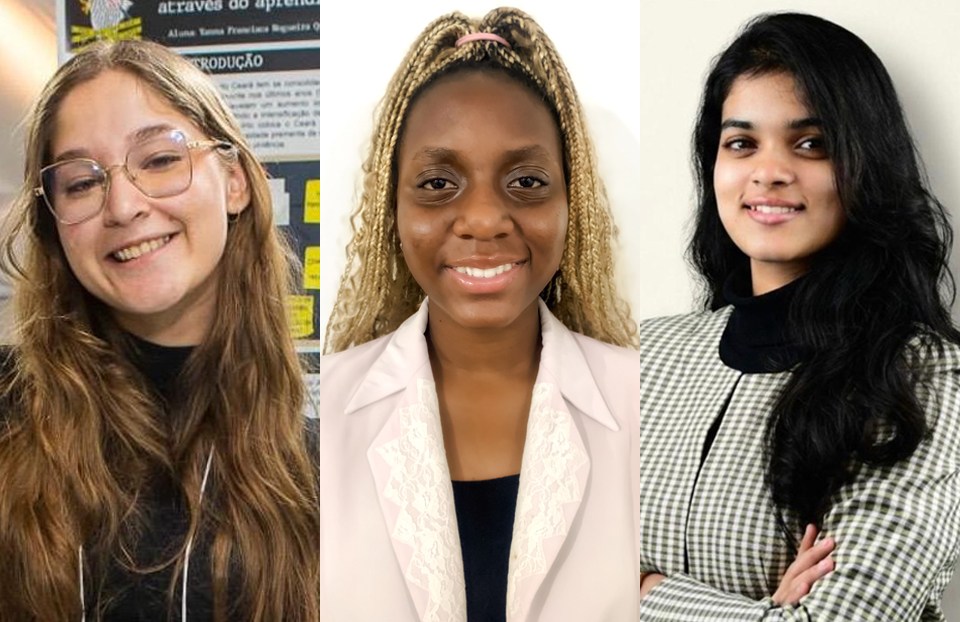
Yanna Queiroz
Iracema, Ceara, Brazil
Yanna Queiroz’s project offers a particularly meaningful connection to International Day of the Girl. She explored ways to better understand feminicide, the intentional murder of women or girls because of their gender, in Ceará, Brazil. Yanna developed an AI system that scans news reports and identifies information about victims and cases that may be missing or fragmented in official records. The findings suggest that AI-assisted analysis could help uncover underreported cases and geographic and demographic patterns, providing officials with more complete information to guide feminicide-prevention policies. Yanna won fourth place in the Behavioral and Social Sciences category for this project.
Ashley Chifamba
Harare, Zimbabwe
Ashley Chifamba, from Harare, Zimbabwe, won third place in the Environmental Engineering category for developing biodegradable sanitary pads made from maize and cornstarch fibers. To mark International Day of the Girl, Ashley shares this encouragement for girls interested in STEM:
“Do not underestimate the value of the question that keeps you curious. Do not let anyone define you or your idea of success. Dare to dream big and have the audacity to act on those dreams. You can do it! You do not need to have everything figured out before you begin. My own research grew from noticing a problem and wondering whether I could create something better. The journey involved experiments that did not work, ideas that had to change, and moments when I had to learn something completely new. But every setback became part of the research. So, to every girl who dreams of becoming a scientist, engineer or innovator: ask the question, start the experiment, and give yourself permission to learn as you go. Your background does not determine the size of the problems you can solve. Your ideas deserve to be explored, and your voice belongs in STEM.”
Anusha Arora
Bellevue, WA, United States of America
Anusha Arora won first place in the Technology Enhances the Arts category and the F. Thomson Leighton and Bonnie Berger Family Prize for STEM Excellence for her AI-Powered music therapy platform. Anusha says, “Representation in STEM matters because people are more likely to picture themselves in a field when they see others like them already contributing to it. For women and girls, it is especially important because they have historically been underrepresented in many STEM fields. Representation can change the question from ‘Do I fit here?’ to ‘What will I contribute?’” Anusha adds, “I also believe STEM becomes stronger when the people building new technologies and solving problems come from diverse backgrounds. More representation means more ideas, more questions being asked and more women and girls knowing that they have a place in shaping the future.”
Aadya Kanchan
Bengaluru, Karnataka, India
Aadya Kanchan won third place in the Environmental Engineering category. In her project, Aadya engineered a better way for cities to withstand heavier rainfall and growing flood risks. She developed a passive vortex insert that sits inside a storm drain and guides incoming water into a swirling motion, helping it move through the drain faster. The low-cost, scalable device could potentially be added to existing drainage systems to help reduce street flooding and waterlogging.
Illaria Liedtke
Rye, NY, United States of America
Illaria Liedtke, from Rye, New York, won first place in the Biomedical and Health Sciences category and the H. Robert Horvitz Prize for Fundamental Research for her project exploring a noninvasive way to treat neurological conditions. Reflecting on the women who inspire her, Illaria says:
“Never stop dreaming! Not only because those before us never stopped, but also because we might serve as a bright beacon for all those who come after us. It’s because of this I’ve always found inspiration and comfort in women in STEM; for example, I’ve always looked up to astronomer Vera Rubin, who pursued astronomy even when institutions and observatories closed their doors to women, ultimately producing work that transformed our understanding of dark matter. I admire women like her not only for forging their own paths, but for making it easier for the next generation to follow. I think we should keep pursuing the questions we care about, so another girl’s path will be a little wider because we did.”