Shrikari Punjala
7th Grade, Quest Academy
Palatine, IL

How Do Calcium Carbonate Crystals Affect Bacterial Growth?
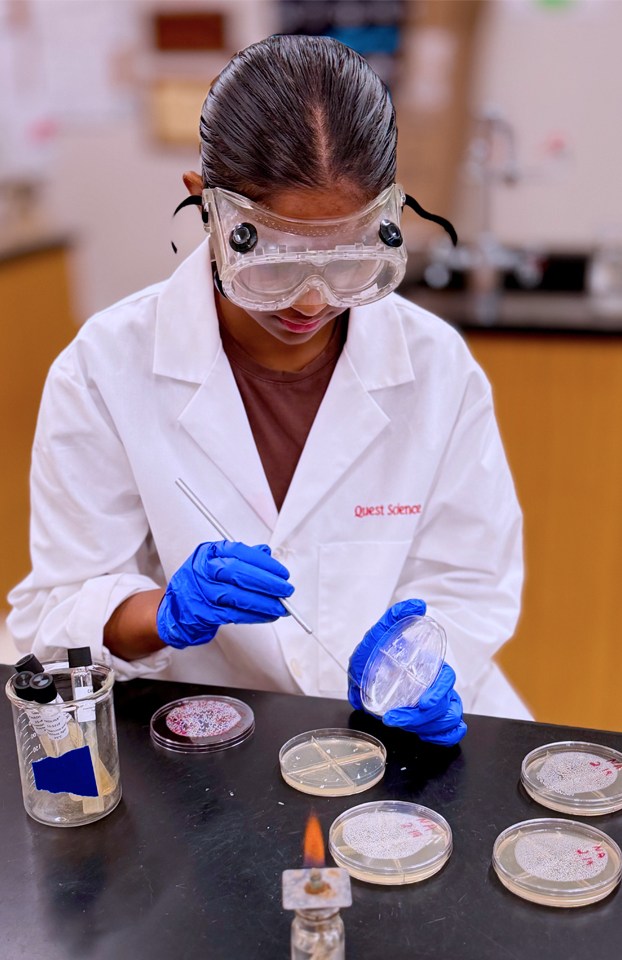
When Shrikari learned about a type of bacteria that could make calcium carbonate crystals, she wondered how calcium carbonate could affect bacterial growth. She extracted calcium carbonate from eggshells, and tested it on four different types of bacteria, and showed calcium carbonate inhibited growth by up to 45 percent.
View Poster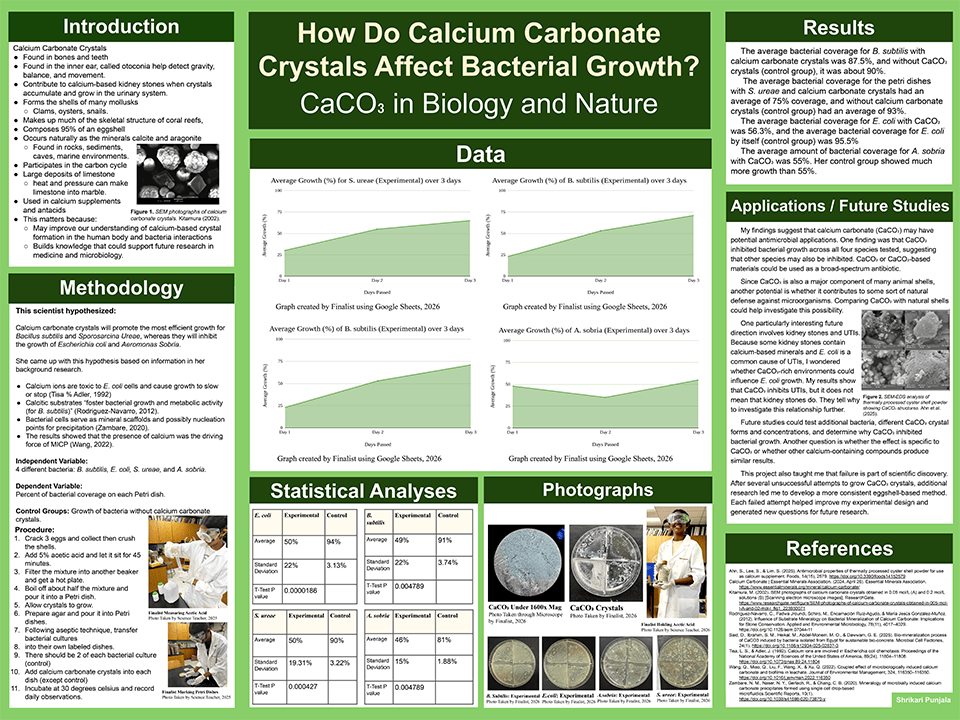
Project Background
Shrikari is interested in microbiology. “I did research on different interesting types of bacteria, until I stumbled across Sporosarcina pasteurii, a bacteria that makes calcium carbonate crystals,” she says. The bacteria could make its own minerals. She began to wonder how minerals like calcium carbonate, found in the human body in the ear and in kidney stones, could affect bacterial growth. In her reading, Shrikari learned that calcium carbonate might reduce the growth of bacteria. She decided to test the hypothesis for herself.
Tactics and Results
From her reading, Shrikari learned that some bacterial species, such as Escherichia coli, might have their growth inhibited by calcium carbonate, while others might prosper. She first isolated calcium carbonate from eggshells using acetic acid. She also grew four types of bacteria on agar plates: Bacillus subtilis (B. subtilis), Escherichia coli (E. coli), Aeromonas Sobria (A. Sobria), and Sporosarcina ureae (S. ureae), incubating them at 30° Celsius for three days. She then added her calcium carbonate crystals to the dishes and measured how much of bacteria growth was either reduced or increased. After calcium carbonate, A. Sobria coverage in the dish dropped to 55 percent, S. ureae dropped to 65 percent, E. coli to 66.25 percent and B. subtilis to 71.25 percent, showing that the calcium carbonate inhibited the growth of bacteria.
Beyond the Project
Shrikari likes playing sports, including tennis, badminton, pickleball and volleyball. She also likes debate. “It has definitely helped me improve my speaking skills, and learning about a topic and trying to find arguments, even if I don’t agree with that side, has changed my point of view for a lot of things,” she says. Shrikari has also competed in the Invention Convention, where young scientists choose problems and develop solutions. “This program is what got me interested in being a biomedical engineer,” she says. Biomedical engineering allows her to combine “the things I love the most,” biology and invention.