Isabella Garry
7th Grade, Central Middle School
Eden Prairie, MN
A Novel Method for Microplastic Removal From Simulated Gastric Fluid Using Plant Mucilage Flocculants
Isabella learned that microplastics are showing up inside people, and decided to find out whether plants that produce mucilages, like okra, fenugreek and psyllium husk could absorb microplastics. Using a model of stomach fluid and microplastics, she showed natural mucilages sucked up 70-93 percent of the plastics within 60 minutes.
View Poster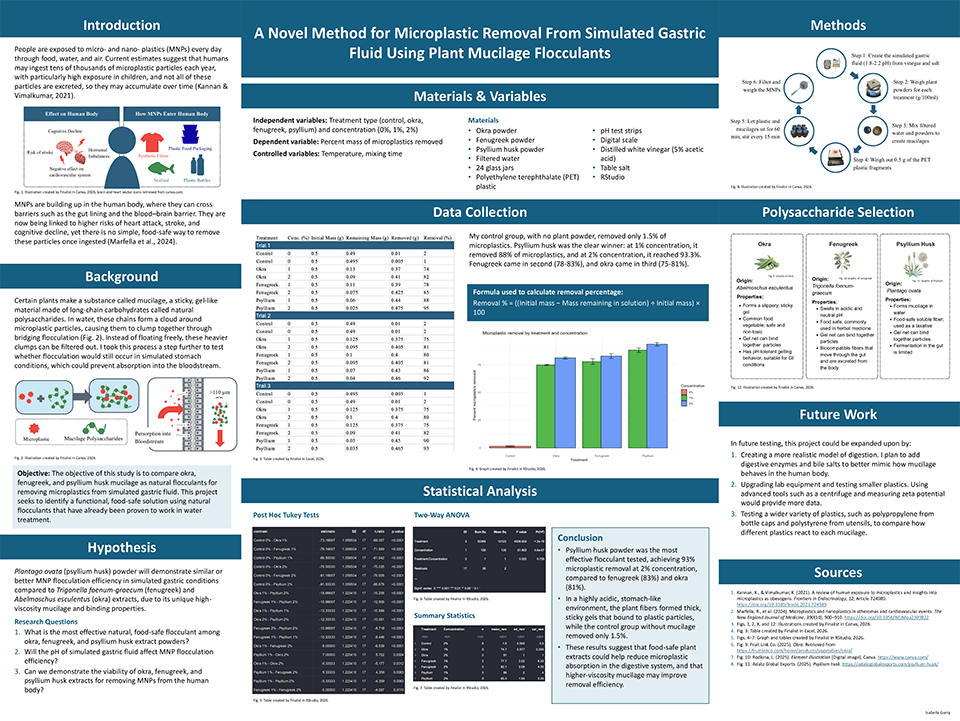
Project Background
“Four years ago, I learned that microplastics were in everything we eat, drink, wear, and breathe,” Isabella says. At first, she thought that people could just avoid plastic. But “when I discovered that babies are being born with microplastics already in their bodies, I knew prevention alone couldn’t solve this,” she says. Isabella decided to find a way to remove microplastics from inside the human body, using natural mucilages, plant compounds that could form gels. The gels, she thought, might be able to absorb microplastics.
Tactics and Results
Isabella started by creating an acidic environment like the stomach using water, vinegar and salt at a pH of 1.8 to 2.2. She sanded down plastic utensils to make microplastics. For her mucilages, she chose okra (Abelmoschus esculentus), fenugreek (Trigonella foenum-graecum), and psyllium (Plantago ovata). These plants all form mucilages in water. Isabella added her one and two percent concentrations of her mucilages and 0.5 grams of microplastics to Mason jars with her acidic fluid, with one jar only water and plastics as a control. She swirled the jars every 15 minutes to simulate digestion, and tested each mucilage 6 times. She then weighed the microplastics left in each jar, to see how much the mucilages absorbed. All of the mucilages removed microplastics from the fluid within 60 minutes, okra removed up to 81 percent, fenugreek 82.7 percent, and psyllium 93.3 percent at the highest concentration.
Beyond the Project
Isabella is a figure skater. She also participates in Technovation, an all-girls coding club and competition, developing apps to solve problems in the world. She has been able to participate in the Technovation Global Challenge, which allowed her to pitch her apps to investors. Isabella would like to become an environmental scientist, and learned from her grandmother that nature and plants can provide many answers. “I have found it critical to protect our earth from the effects of plastic, i.e., micro- and nano-plastics, because it is my responsibility to protect the earth’s healing properties,” she says.