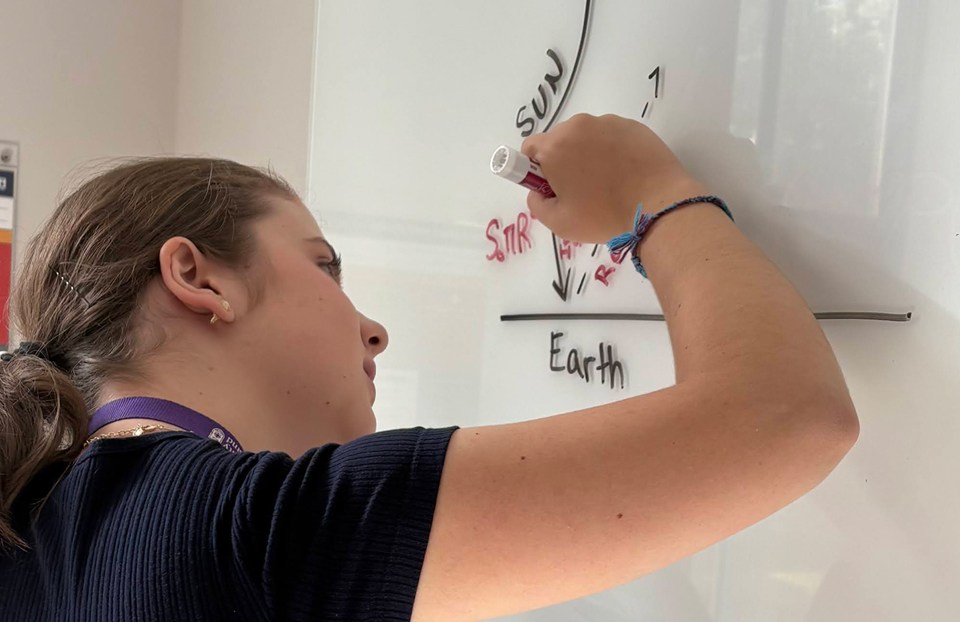
Isabel Rossi
8th Grade, James Blair Middle School
Williamsburg, VA
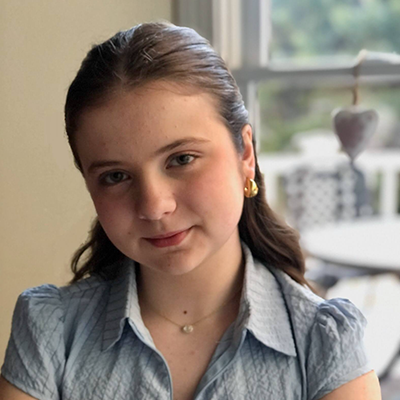
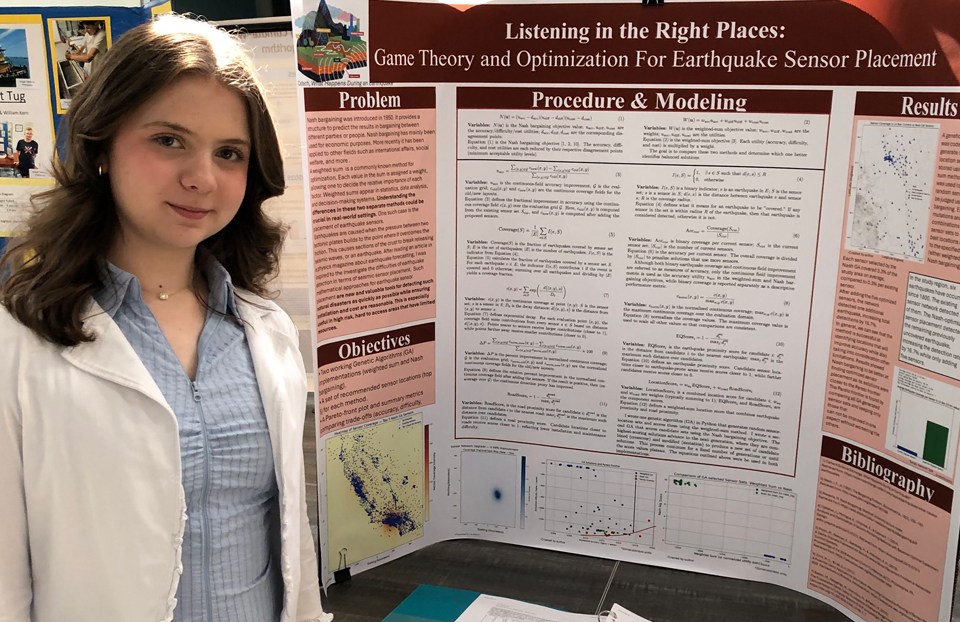
Listening in the Right Places: Game Theory and Optimization for Earthquake Sensor Placement
Placing earthquake sensors is a balance of being able to access the sensor, and having it detect shakes. Using a set of earthquake data and sensors from the Los Angeles area, Isabel tested game theory models to place earthquake sensors and found the Nash bargaining model produced the best placements.
View Poster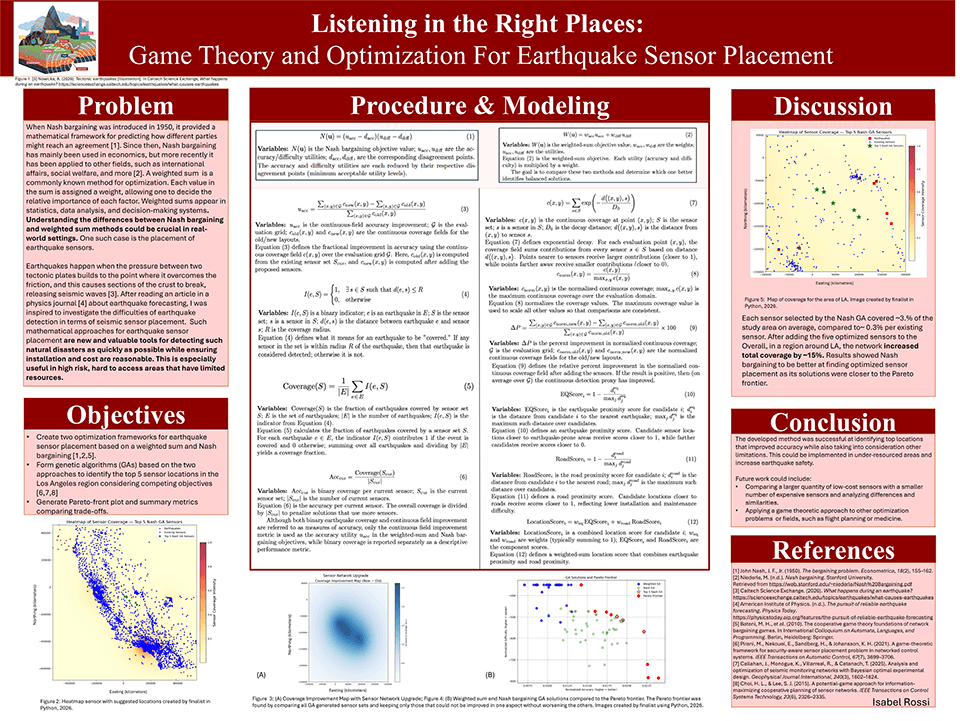
Project Background
Isabel admits most middle school students probably don’t read old Physics Today magazines for fun, but that’s where she came across an article about the challenges scientists face when trying to detect earthquakes. “I had experienced a big earthquake myself, which really frightened me,” she says. Isabel recently enjoyed learning about game theory—mathematical ways to come up with the best decisions for different players in a game. Isabel realized she could apply game theory to determine where to place earthquake sensors.
Tactics and Results
Isabel decided to consider the variables in placing earthquake sensors, such as sensor accessibility and earthquake detection accuracy, as players in a game. She compared two different mathematical models — a weighted sum model and Nash bargaining — to predict where earthquake sensors should be placed. Isabel decided to focus her experiment on the Los Angeles region in California, and used a data library with a record of both earthquakes in the region and where the sensors were located. She coded a program that produced random sets of earthquake sensor locations and had her two mathematical models pick the best one. The best locations would be closest to the Pareto frontier, which is a solution where no one sensor placement could be improved without harming others. Isabel found that Nash bargaining produced results closest to the Pareto frontier, with a model that could improve coverage by 16.7 percent using only five extra sensors.
Beyond the Project
Isabel truly loves math. “I like the precision of it,” she says. “Over time it’s become one of my favorite free time activities.” But she also enjoys music and plays violin in the Williamsburg Youth Orchestra. “Music is often viewed solely as an art, but it’s just as tied to math,” she says. “The distance between frequencies, time signatures, and space between notes on my violin fingerboard are precise and calculated.” Isabel would like to be an aerospace engineer. “There’s so much to discover about our world. I want to take part in that,” she says.