Bailey Quinn Frank
8th Grade, Pine Crest School – Fort Lauderdale Campus
Fort Lauderdale, FL
Designing an eDNA Sampler To Provide Health Surveillance Through the Detection and Identification of Bacterial Pathogens in Rural Communities
Bailey made a sampler for environmental DNA out of a fan and filter paper to monitor environments for pathogens. She grew bacteria from indoor and outdoor samples. Her indoor samples had more types of bacteria associated with people, while outdoor ones were associated with trees and soil.
View Poster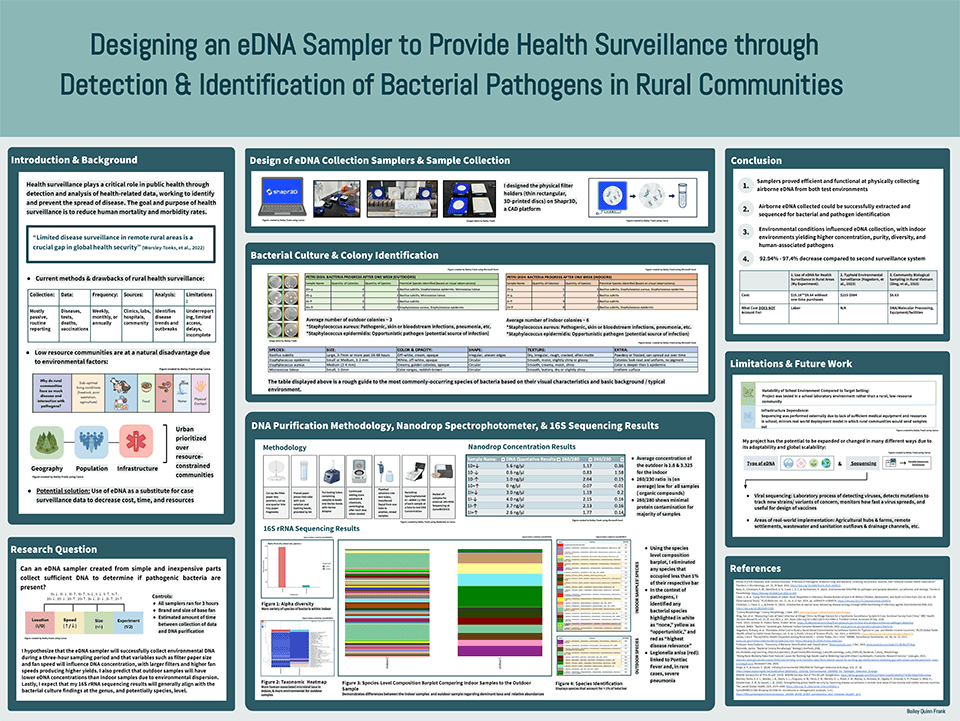
Project Background
Bailey recently learned about environmental DNA (eDNA), and that it is used to capture genetic material from the environment to determine which species are present in an area. She also learned about health surveillance—how scientists track diseases as they spread. Bailey was concerned to learn that health surveillance is often difficult in rural areas with few resources. “I decided to further explore if an eDNA sampler constructed from inexpensive materials could efficiently collect airborne DNA that could then be applied to pathogen detection,” she says.
Tactics and Results
Bailey started by making samplers that could collect eDNA. She bought small fans and attached filter paper to them. When she turned on the fans, the air would be pulled through the fan and through the filter paper, leaving eDNA behind. She collected two samples of indoor air and one sample of outdoor air. Bailey purified the DNA on the papers, and transferred half of the sample to petri dishes to grow bacteria she collected. After one week, she recorded the number of bacterial colonies and tried to identify them. Bailey also sent off her best samples to have them sequenced for 16S rRNA to identify the bacteria. She showed indoor air samples contained more genera of bacteria and more human-associated bacteria. Outdoor samples had bacteria from soil, water, air and plants. She hopes simple and cheap systems like hers could help people in rural areas do surveillance for bacteria.

Beyond the Project
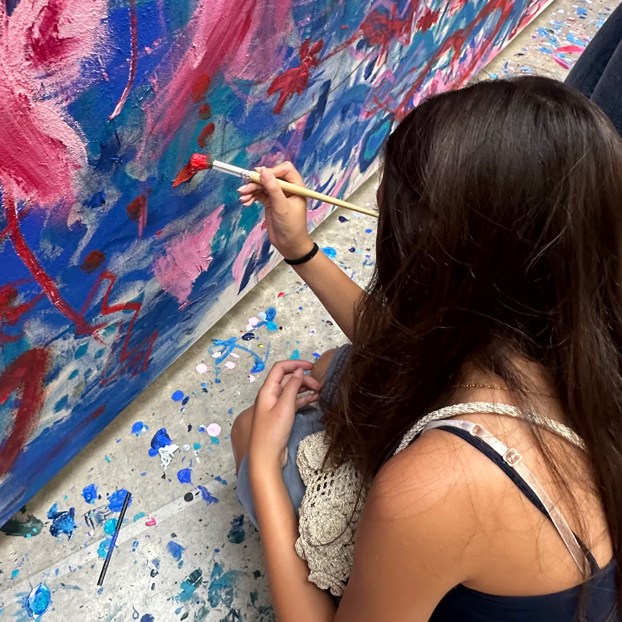
Bailey was inspired to learn more about health and the human body in part because of her own experience with celiac disease, she says. “It allowed me to develop empathy at a very young age for other kids and adults alike who are different from their peers,” she says. She loves making art, from digital art to watercolor, fabric and clay. But her favorite activity is the Technology Student Association. “It has helped me build fundamental technical skills through events such as Community Service, Medical Technology, Career Preparation, and Leadership,” she says