Ankith Burki
7th Grade, BASIS Independent Silicon Valley
San Jose, CA

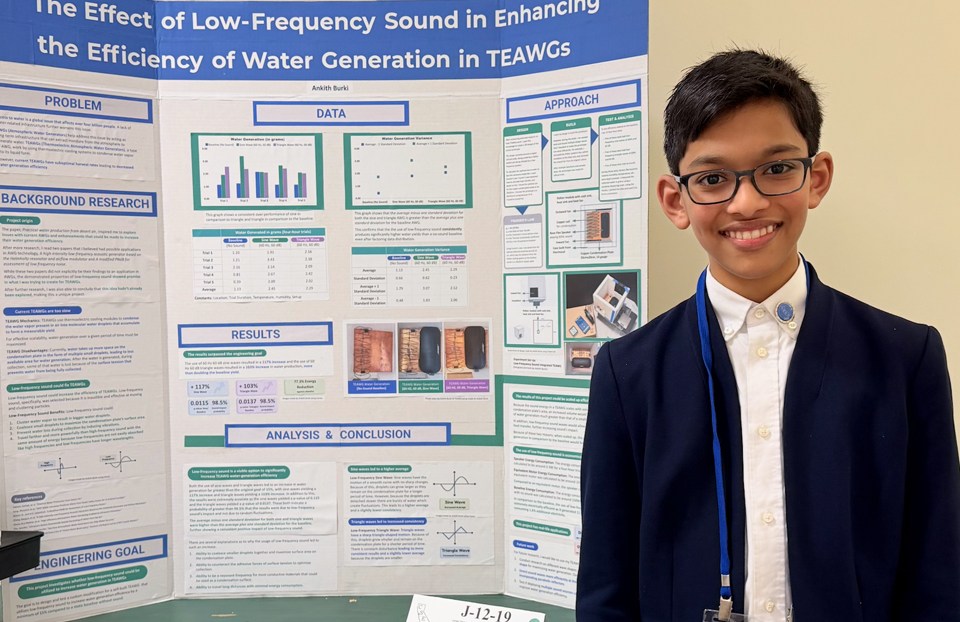
Investigating the Effect of Low-Frequency Sound in Enhancing the Efficiency of Water Generation in Thermoelectric Atmospheric Water Generators
Water scarcity affects more than 4 billion people. While atmospheric water generators pull water out of humid air, they can be inefficient. Ankith built and tested an atmospheric water generator and showed that low-frequency sound could increase the amount of water pulled from the air by 117 percent.
View Poster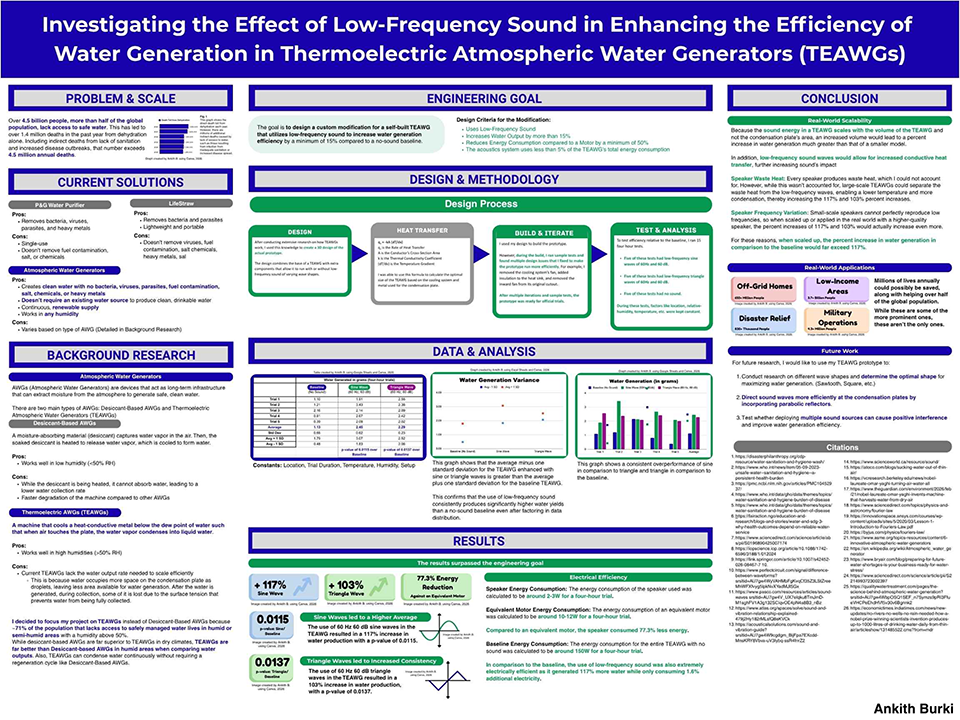
Project Background
Ankith knows that more than 4 billion people don’t have enough access to fresh water, and that water problems will only increase with climate change. One way to get drinkable water is to use atmospheric water generators, which extract water from humid air. But currently they don’t have very good output. Sound-induced vibrations “could coalesce water droplets and cluster water vapor, both of which would maximize water generation,” Ankith says. He decided to modify an atmospheric water generator with low-frequency sound to see if he could generate more water.
Tactics and Results
Ankith started by designing his own atmospheric water generator, using a mechanism called the Peltier effect, which transfers heat from one side of a material to the other with an electric current. After several trials, he got a prototype that could reduce the temperature around it by 7.5°C, dropping below the dew point of water in the environment, allowing water to collect. Then he ran his water generator in sets of four-hour tests. 5 tests were in silence, and 10 more were with low frequency sound in two different waveforms—a sine wave or a triangle wave—played through a speaker. The sound would force water droplets to come together. Ankith then measured how much water his generator produced in each condition. He found that the low-frequency sine waves increased the water collected by 117 percent.
Beyond the Project
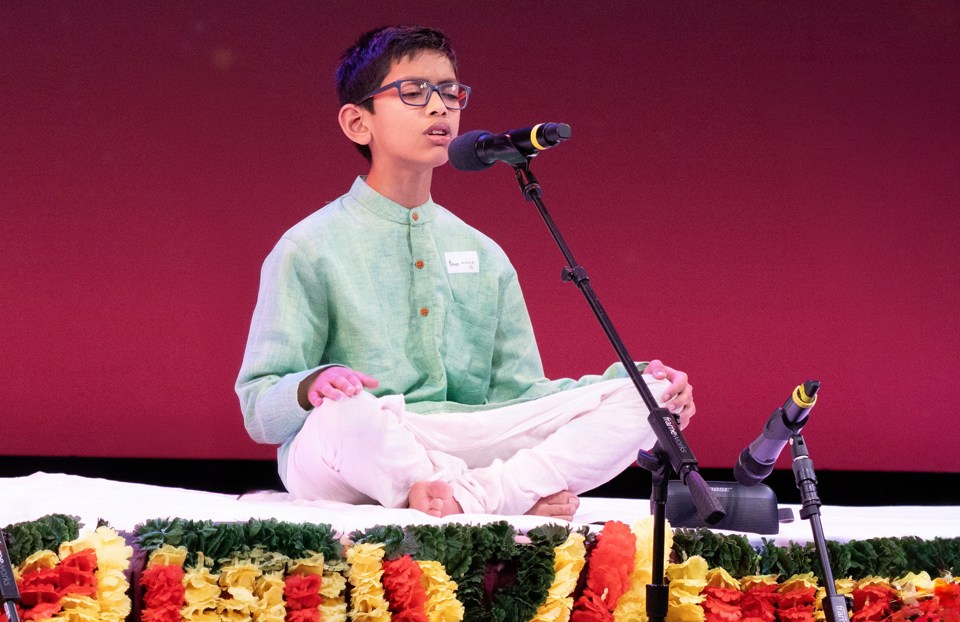
Ankith is a singer and performs Indian Carnatic Classical vocal music. “Practicing and singing the traditional Indian music that my ancestors have learnt for generations is soothing and helps me connect with my cultural roots,” he says. He would like to become an environmental engineer. “I have been fortunate enough not to have faced any significant personal hardship,” he says. “I have a responsibility to create solutions that are accessible to those with fewer resources and opportunities than me.” Being an environmental engineer would help him “create a healthier, safer, and overall better place for us to live in.”