The Telescope Didn’t Discover Jupiter’s Moon: Michael Tavarez on AI at 2026 Research Teachers Conference
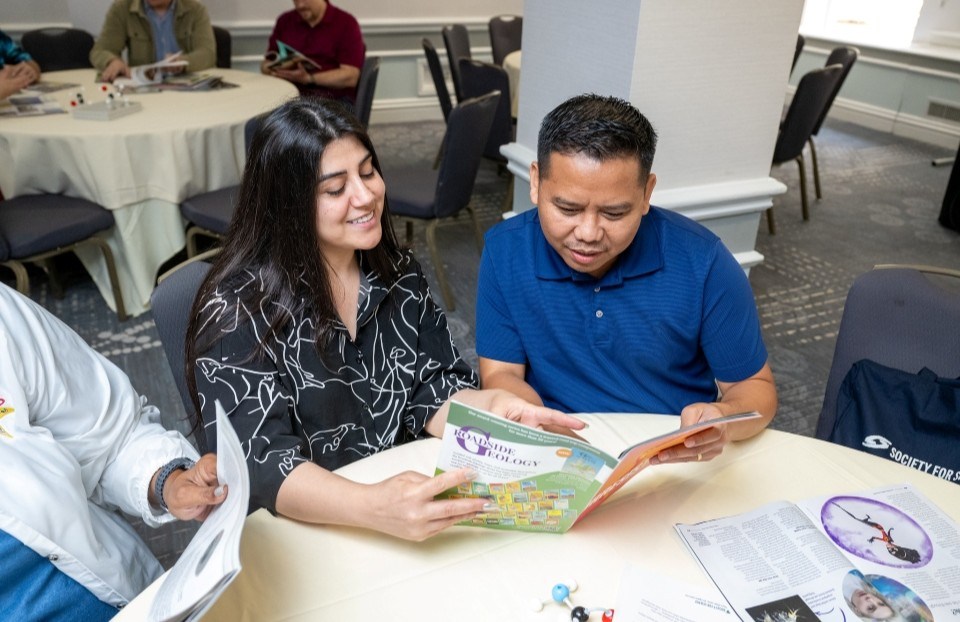
In October, Society for Science hosted 200 middle and high school STEM and research educators for the annual Research Teachers Conference. The teachers had an action-packed weekend in Washington, D.C., consisting of plenary sessions as well as a keynote speaker. Breakout sessions covered topics such as tools and strategies for managing student research projects, supporting students in research communication and supporting students underrepresented in STEM
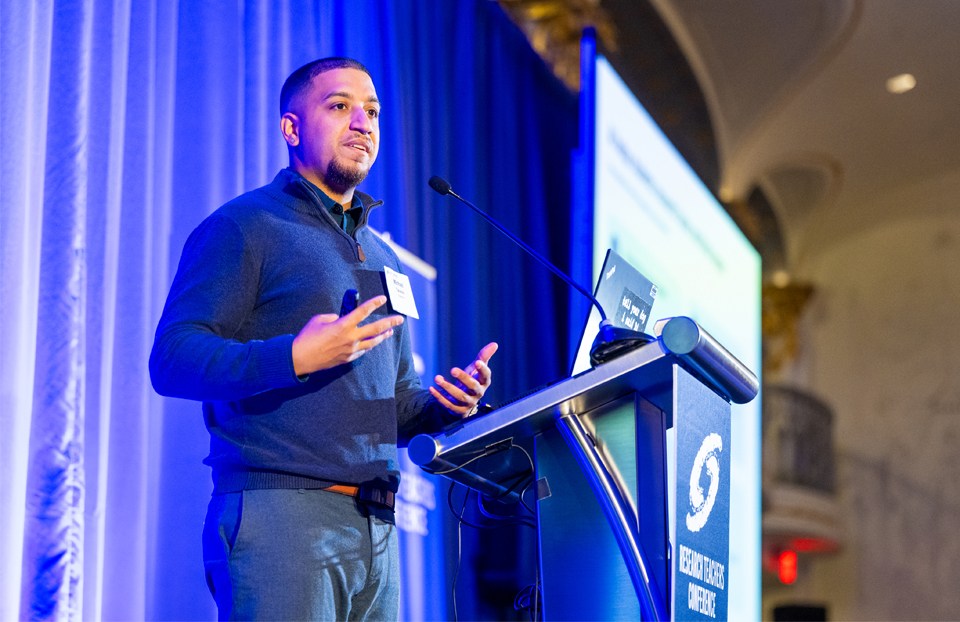
In his keynote, Michael Tavarez, Ph.D. an Associate Manager in Research Program Management at Regeneron, encouraged educators to think of AI as a tool scientists can use in their research. He sees AI as not a replacement for science, but rather a tool on the belt.
Mike opened his talk by sharing a sentimental moment before beginning his talk on AI with a photo of his science educator in 6th and 7th grade.
Tavarez opened his talk by sharing a photo of the science teacher who taught him in sixth and seventh grades.
“I want to highlight that Ms. Kurgois was extremely special to me. I’m sure you all have a Ms. Kurgois in your life,” Mike says. “I’m sure you all will be a Ms. Kurgois to your students in their lives.”
After his opening remarks on his science teacher, he began the discussion with his own journey into STEM as a plant scientist.
Growing up in the Bronx, Mike saw his family’s commitment to education and followed in their footsteps by attending Lehman College. He initially considered medicine, then set his sights on dentistry after a life-changing experience with braces. Volunteering in a research lab introduced him to another possibility: he discovered a love of science, earned a paid lab position and published a paper as an undergraduate. When he missed the dental school application deadline, he returned to Lehman for a master’s degree in biology.Research experiences at the University of Nebraska–Lincoln and the Royal Institute of Technology in Stockholm broadened Mike’s horizons and connected him with a wider scientific community. His interest shifted from dentistry to a Ph.D. in plant science. During his graduate school experience, he also discovered a passion for teaching. After struggling to explain concepts to students, he practiced with his mother and learned to adapt to his approach, ultimately setting his sights on becoming a college professor.
After graduating, Mike took a university position teaching biology. Three weeks later, a call from Regeneron opened a different path into Research Program Management. Today, he helps research teams carry out their work by developing tools and training people to use them, with a strong focus on artificial intelligence.
Mike invited the educators to draw what they imagined a scientist looked like. He then showed them examples of what PowerPoint and Google images, along with his niece’s interpretation. As a mix of images appeared on the screen, Mike pointed out a familiar stereotype that surfaced in several of them: preconceived notions of men wearing lab coats and glasses.
“I am still a scientist even though I do not wear glasses anymore,” Mike said with a chuckle. “I also heard some amazing talks about people studying marine science yesterday, and I promise you, it’s probably not likely that you’re going on a boat in a lab coat and your goggles.”
This drawing exercise set up Mike’s next point. Few, if any of the educators in attendance drew a computational program. Essentially, no one was claiming that AI tools such as ChatGPT, Claude and Gemini are seen as scientists themselves, but rather they are tools that can help scientists with their work, he explained. .
“There’s a lot of fear and thoughts about AI replacing people’s jobs, but I want to stress AI will never replace a scientist,” Mike said. “There’s absolutely no way. Because a scientist is not defined by how they look. We define scientists by what they do.” Mike went into a deep dive about how curiosity is what makes a scientist.
Questions are what brought the leading drugs and medicines into fruition. Mike pointed to Regeneron’s first research paper, published in 1990, and listed some of the tools researchers used to identify a new protein, including pipettes, glassware, centrifuges and computers.
“The fact is that being a scientist is a job, and every job has tools,” Mike says. “Lawyers have tools; educators have tools. We all have tools that we use to help us do our jobs, but no tool in and of itself is doing the science.”
Mike pointed to the microscope as an example of how scientific tools evolve. Today, researchers can use microscopes to create 3D images and examine sliced images layer by layer, looking at microscopic things in ways that weren’t imaginable.
Mike encourages students to learn how to use AI responsibly in a classroom. He stressed that AI should support their research but not take over the process. He offered a few examples of what that looks like.
“AI can help summarize dense papers,” Mike said. “AI can help analyze data faster.”
Mike then brought up examples of positive AI usage in research such as AI accurately predicting a protein structure, helping researchers predict binding sites to help slow down the production of a protein.
Another example is an MIT team that used AI machine learning to successfully create predictions and approaches to developing new antibiotics, Mike says.
“From early discovery to late discovery, we have scientists using AI in different ways,” Mike said. “I hope you get from this, that AI is a tool, and I would love if you all could encourage your students to continue to use it as a tool specifically, because of course the telescope didn’t discover the moon, Scientists discovered it. Your student scientists will make the discovery, not the AI tool.”