Five Questions with Camila González-Thompson, winner of the $10,000 Robert Wood Johnson Foundation Award for Health Advancement
At the 2025 Thermo Fisher Scientific Junior Innovators Challenge (Thermo Fisher JIC), the then 14-year-old Camila Isabel González-Thompson of Ponce, Puerto Rico, received the $10,000 Robert Wood Johnson Foundation Award for Health Advancement. The award recognizes the student whose work and performance shows the most promise in health-related fields and demonstrates an understanding of the many social factors that affect health.
Camila’s project examined blood samples from Puerto Ricans for antibodies to dengue virus and showed that the virus is endemic to Puerto Rico, helping public health officials better target interventions. Earlier this year, Camila was featured in Forbes for her research investigating dengue transmission in Puerto Rico and its implications for public health. She was also the first Puerto Rican student to receive a top award at Thermo Fisher JIC.
We caught up with Camila to learn more about her experience at Finals Week, what she learned from fellow finalists and what advice she has for future applicants.
During Finals Week in Washington, D.C., when did you feel most like yourself, not just as a young scientist, but as a person?
The first time I remember truly having a good time and feeling like myself was when I went out to dinner with the other finalists. Up until then, we had been friendly, but we hadn’t really had the chance to connect on a deeper level. That dinner changed everything.
It was the moment I started forming some of my strongest friendships at Thermo Fisher JIC. Before that night, I had been feeling stressed and focused on proving myself, which made it hard to relax. But being surrounded by people going through the same experience helped me let my guard down. From that point on, I felt more comfortable, more confident and genuinely excited to spend time with the people who quickly became my friends.
What’s something another finalist said or did that stuck with you? Or is there something you learned from a fellow finalist that you’d like to share?
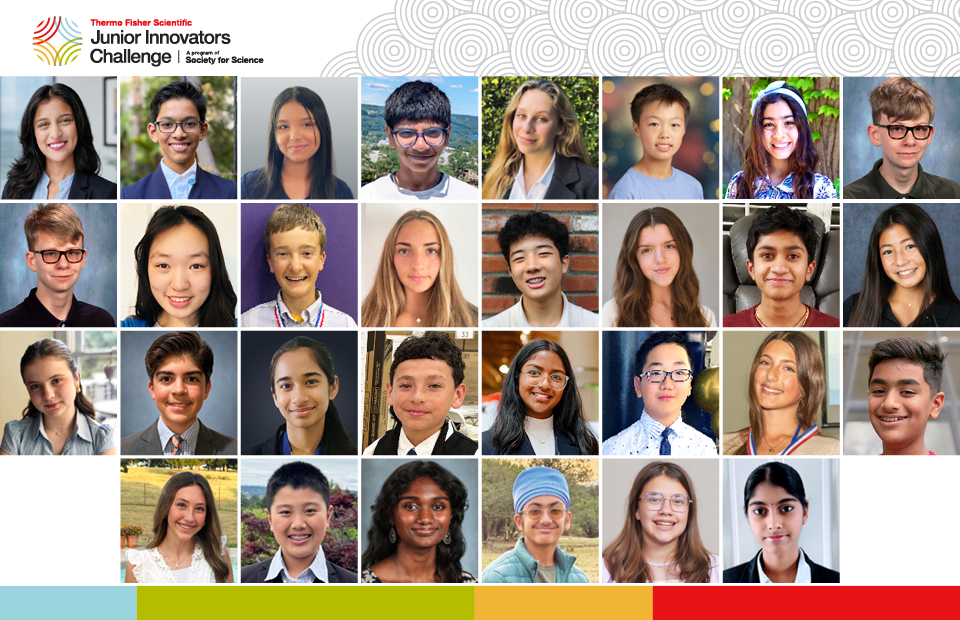
There is so much to learn from 29 different people in a room with you that it’s hard to name only one thing. So I’ll just say that the exchange of different finalists’ points of view and daily lives really stuck with me.
Living in Puerto Rico, I had never really realized how much my day-to-day life differed from a typical American school environment. It helped me expand my worldview and see how differently people live and learn depending on where they are.
If you had unlimited time and resources, how would you take your idea further or in a completely new direction?
Having unlimited time and resources would allow any scientist to expand their research much further than they otherwise could. For me, that would mean growing my participant pool and obtaining an equal number of participants across all categories.
In my opinion, the biggest limitation of my project was the inability to determine dengue infection trends by sex and municipality. That was mainly because I wasn’t able to obtain an equal number of participants from all municipalities and both sexes. Some municipalities had representation in the hundreds, while others had as few as 10 people.
While this was outside of my control, due to time and financial constraints, we were not able to balance the data as originally planned and had to move forward using the information we had rather than waiting for additional data. With more time and resources, expanding the study could have revealed significant findings that were not possible to identify in the current project.
What’s a question you wish adults asked you more often about your research, or about being a young scientist?
Everyone has a part of their project that they enjoyed a little more than the rest, or a part of their research that they found slightly more interesting than everything else. But there comes a point in your presentation when every adult around you asks the same four questions about the same topics over and over again.
When you get back to your room at night and lie down to sleep, you realize, “I never really got to mention that one thing I researched.”
For me, that was the history of dengue epidemics in Puerto Rico. I spent countless hours brushing up on the subject and trying to find papers from as many reputable sources as I could. But at the end of the day, I didn’t really get to elaborate on it as much as I would have liked. Nerves got the better of me, and I focused on the science and accidentally left the story of why the science was important as an afterthought.
Before you applied, what did you think the competition would be like, and what surprised you once you got there?
Before applying, I expected the competition to be friendly, but I also anticipated a highly intense and stressful environment. I spent the weeks leading up to the competition watching videos from previous years and studying to see if there was anything I should be prepared for.
As I began receiving my schedules and counting down the days, my excitement grew, though I quietly worried that others might be overly serious and uninterested in connecting. In reality, while the competition maintained a level of seriousness, it was far more supportive and enjoyable than I had imagined.
Although everyone hoped to win a top prize, there was a shared understanding that outcomes were uncertain, which created a more relaxed and encouraging atmosphere. More than anything, the experience became an opportunity to meet people who shared a passion for science and build friendships that extended beyond the final awards ceremony.
What would you say to a student who’s unsure if their project is “good enough” to apply?
I was once in that position where I believed my project wasn’t good enough.
When I was first nominated for Thermo Fisher JIC, I didn’t really understand the competition that well. So, I started searching online, and when I saw all these amazing inventions, I thought I wasn’t going to win anything. Since my project didn’t invent anything or create a magical solution, I assumed it wasn’t good enough to compete, much less qualify.
I filled out my application and attended the seminars, but to be honest, I expected so little that I hit submit and forgot about it completely. When I first made the Top 300, my mother told me, “You know, Finals Week is at the end of October,” and I ignored her because I thought that was it. Then I made the Top 30 and thought my luck had to have run out by then.
I went to Washington, D.C., hoping for a certificate, an experience and a good time. Then hearing my name called during the awards ceremony was surreal, and it still plays back in my head at least once a week.
The moral of the story is that even if you think you aren’t supposed to be there, the world has funny ways of making things happen.
Applications for the 2026 Thermo Fisher Scientific Junior Innovators Challenge are open now. Learn more and apply at https://thermofisherjic.smapply.org/. Applications close June 10, 2026, at 8:00 p.m. ET.