STEM Action Grants, STEM Outreach
Bringing hope and courage through science education

Because pediatric patients sometimes require long hospital stays, they often miss school or lack social interaction with peers. Days full of procedures can push play to the sidelines. This can lead to a sense of isolation and sadness. That’s where the global nonprofit, TEACH, which stands for Together Educating All Children in Hospitals, has stepped in.
For the past seven years, undergraduates and medical students from
15 universities have volunteered in about 30 hospitals worldwide to bring engaging,
hands-on educational programming to hospitalized children, sparking their
interest in science and natural phenomena. And perhaps most importantly, they’ve
lifted the spirits and confidence of thousands of sick children.
Last year, TEACH was the recipient of a $2,500 STEM Action Grant, which they’re using to expand programming to hospitals in Maryland and Michigan, as well as supplies in current branches. Since its inception, TEACH has reached more than 3,400 children, with over 700 served in 2019 alone.
TEACH modules are creative and interactive, with activities
ranging from playing with silly putty to learn about polymers, to building
bridges out of gumdrops, to using lava lamps to exhibit density
or creating paintings out of salt. The activities are crafted to ignite kids’ STEM
imagination. The modules come with one-page manuals, instructions,
illustrations and resources. The experiments and activities, which are both
developed and led by the volunteers, impart STEM concepts suited for children ages
3-21 in both inpatient and outpatient settings. They include two module
activities at all of their events; one tailored to elementary- age children,
the other for teenagers.
Isaac Snyder, TEACH Executive Director and student at the
Philadelphia College of Osteopathic Medicine, shared that it’s heartwarming to
watch the older teenage patients help the younger patients with some of the
more advanced activities, such as engineering experiments. TEACH expands
experiences beyond the typical coloring books, movies or games on a tablet. According
to Isaac, this is an opportunity to teach kids about how science applies to
their own illnesses. Besides inspiring kids to see science in a new light, the
modules help kids understand the diseases that are putting them in the
hospital.
“This can alleviate their fears and help them to have a positive
attitude towards science,” Isaac explained. Sharing the example of using a sickle
cell module to explain the disease to a sick child, Isaac said, “Play-Doh and
clear plastic tubing are used to explain what happens with sickle cell disease
and how it causes a sickle crisis in these children.”
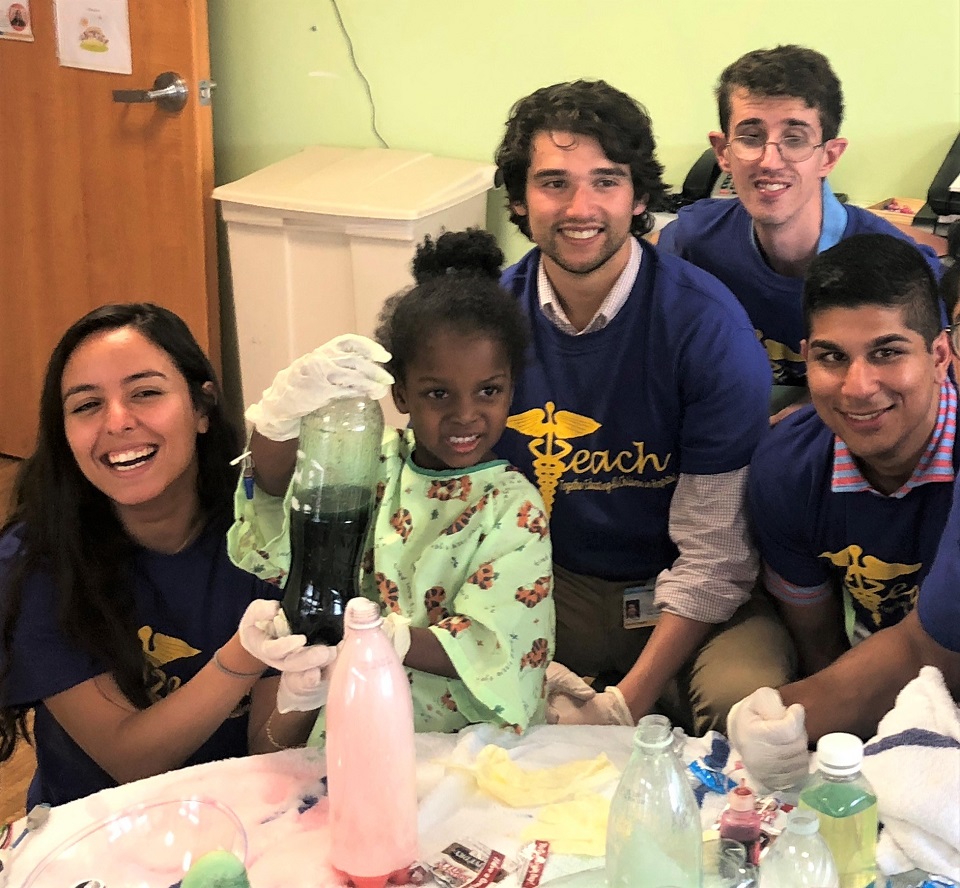
Photo courtesy of TEACH/Isaac Snyder
Isaac knows TEACH can inspire volunteers to pursue medicine. Though
he started out as just a volunteer, Isaac was eventually inspired to pursue
medicine and make a difference in the lives of pediatric patients. The
organization welcomes student volunteers to create modules as well as test and
implement them in hospitals.
Watching the sick patients light up while completing the TEACH
modules definitely inspires the motivation of the volunteers. Isaac shared an
anecdote about a child who tried to run away from the hospital the day before one
of the first times he volunteered. Knowing the child had tried to run away,
Isaac taught the module by the child’s bed.
“I was able to get him to come out from under the covers, and he
enjoyed the experiment so much that he wound up not letting the staff take it
away from his bed all day!” Isaac explained. “I truly believe that the joy
TEACH brings to the children, helps them to have better outcomes medically.”
Jared Silverberg, the president of TEACH’s University of Michigan
branch, echoed Isaac’s assessment. “We had a young boy who was at the module I
ran in January. While seeing him still in the hospital was disappointing, watching
him get messy, have fun and shift his attention away from the other daily
events he experiences in the hospital for a brief period at our module just
made the entire day so worthwhile and rewarding!”
When the Society asked Isaac what he’s witnessed in the patients’ emotional state and spirit as they engaged in TEACH’s programs, he shared: “The feedback we received from one of our volunteers a few years back sums up this question the best— the parents told the volunteer that this was the first time their child had smiled in days, and they were so relieved.”
Interested in volunteering or getting involved with TEACH? Find out more here.